Sean Mastel: Building Eyewear to Last · Fargo INC!
Businesses
Sean Mastel: Building Eyewear to Last
After more than 20 years in the optical industry, Sean Mastel is opening Mastel Made, a downtown Fargo studio handcrafting eyeglass frames designed to last, not disposable eyewear replaced every few years.
In shortAfter 20-plus years in the optical industry, Sean Mastel is opening Mastel Made in downtown Fargo on August 18, a studio handcrafting eyeglass frames built for longevity rather than replacement.
3 things to know
1Mastel Made will operate Tuesday–Thursday 10 a.m.–6 p.m. and Friday 10 a.m.–1 p.m., with appointments available outside those hours.
2Frames from the regular collection are expected to sell for approximately $295; fully bespoke projects, such as horsehair commissions, can reach around $1,000 or more.
3A defining feature of Mastel's frames is real, hand-installed riveted hinges—functional structural components that can be serviced—contrasting with decorative rivets common on mass-produced frames.
Generated by Claude · grounded in this articleNever used on sponsored content
By Brady Drake | Photos provided by Sean Mastel
Sean Mastel: Building Eyewear to Last
Sean Mastel was already giving a studio tour when the interview began.
His wife, Angela, was showing a friend around the couple's newly leased spaces in downtown Fargo. One will house Sean's eyewear production and Angela's future art classes. The neighboring space will become a retail showroom and consultation area, where customers can sit down with the person who will design, shape, and finish the frames they take home.
The move was still in progress. The spaces were not yet fully fitted out, and Mastel was wrestling with technology as the call started. But the larger transition had been years in the making.
After spending more than 20 years in the optical industry, Mastel is finally giving his full working day to the craft he once squeezed into evenings, weekends, and spare hours in the family basement, making eyeglass frames by hand.
Mastel Made will open August 18, and hours will be Tuesday-Thursday from 10 a.m. to 6 p.m. and Friday from 10 a.m. to 1 p.m. They are available for appointments outside of these hours.
The Job That Fit
Mastel did not begin his career with a plan to make eyewear.
At 19, he was studying pharmacy. He soon concluded that the work was not for him and took a break from school. Angela, his high school sweetheart and eventual wife, had begun working at an eye clinic with a friend. She urged him to give the optical field a try.
Her pitch was simple — it combined medicine, fashion, and technical work.
Mastel immediately recognized the fit.
"It's somewhat medical, it's somewhat fashion, it's somewhat technical," he said. "It interested me right away, and I've just been doing it ever since."
What first captivated him was not the fashion side of eyewear but the lenses. He worked in optical manufacturing, grinding and fitting lenses into frames. It was precise, hands-on work that required an understanding of both the prescription and the physical object carrying it.
To Mastel, that part of the profession remains underappreciated. Most people notice the frame first, but the lens is where optics, measurements, materials and human vision converge. He sees the deeply involved optician, the practitioner who understands how a lens is made, positioned and adjusted, as part of a craft that is gradually disappearing.
Making frames became the next step in preserving that craft.
The idea began with wood. Mastel's father-in-law is a woodworker, and after Sean saw examples of wooden eyeglass frames, his first reaction was the reaction of a natural maker.
Wood ultimately proved less practical than he had imagined, but the problem had taken hold of him. How was a frame constructed? How could the shape be altered? What materials could be used? How could he make something that fit one person better than anything available on a display wall?
About six years ago, he began finding out.
Designing Around the Person
Mastel's earliest projects were custom frames for people who could not find what they needed through conventional eyewear lines.
Some were difficult to fit. Others had a particular shape or color in mind but could not find it in the right dimensions. Some simply knew that the frames they were trying did not feel right, even if they could not explain what they wanted instead.
ach shape starts with the person who'll wear it, not a catalog.
Mastel could begin with a blank page or reinterpret an existing idea. A customer might like the front of one frame but need it wider. They might want a familiar silhouette in an unavailable color. They might need the bridge, temples, or proportions redesigned around their face.
The process reversed the logic of ordinary eyewear shopping. Instead of asking a person to adapt to the product, Mastel adapted the product to the person.
As his confidence and equipment improved, he began creating a collection of his own designs. Several grew out of extended conversations with individual clients. When a custom shape seemed capable of working for other people, he would ask the original customer for permission to include a version in his line.
His frames eventually found a retail home at Eyes on Broadway in downtown Fargo. When they began selling there, Mastel saw evidence that the appeal extended beyond a handful of custom clients.
Success created another problem, a lack of time.
Mastel had substantial responsibilities at Eyes on Broadway and its Mayville location, many of them unrelated to producing frames. The actual making took place at home, where he and Angela maintained studio spaces in the basement. He worked around his job and family life with their two daughters.
Opening his own operation changes that equation. Frame making is no longer the thing he gets to after the day's other obligations. It is the day's work.
It also allows him to sell directly to customers. With fewer layers between maker and wearer, Mastel believes he can keep the collection more accessible than comparable handcrafted eyewear. At the time of the interview, he expected frames from his regular line to sell for approximately $295. Fully bespoke projects can cost considerably more, depending on their materials and complexity.
An Old-School Answer to Disposable Eyewear
Mastel's designs may vary, but they share a philosophy: a good frame should not feel temporary.
He is drawn to objects made 30, 40, or 50 years ago, not simply because he prefers vintage styling, but because many of those objects were built with repair and longevity in mind.
Stuff nowadays isn't made to last anymore. I wanted to make frames that were meant to last a long time.
He has watched customers purchase frames, wear them for a relatively short period, and replace them when a component fails, or a new insurance benefit becomes available. To him, that cycle is both wasteful and unnecessary.
"I wanted to make frames that were meant to last a long time," he said.
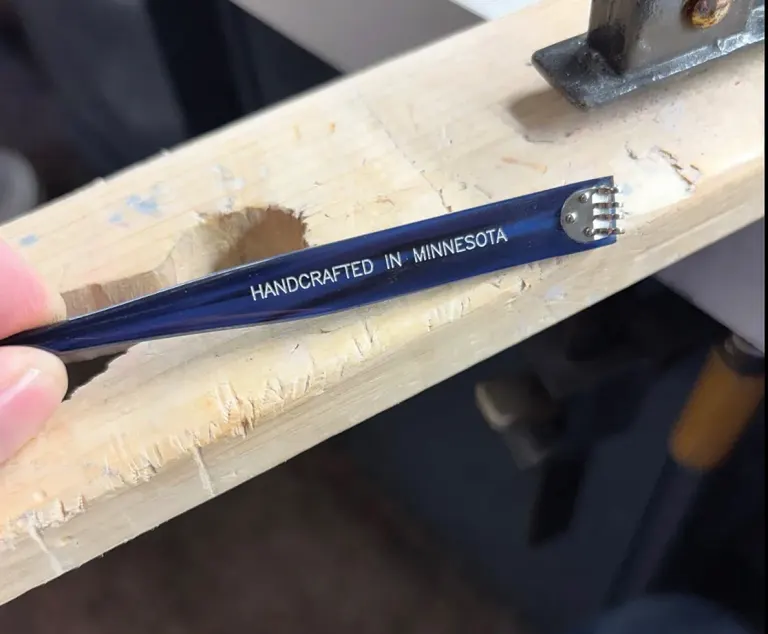
That goal is visible in one of Mastel Made's defining details: real, hand-installed riveted hinges. On many mass-produced frames, the dots resembling rivets are primarily decorative. Mastel's rivets are working structural components. They can be serviced and repaired, and he believes they provide the resilience associated with older frame-making traditions.
A Mastel Made frame in progress, stamped "Handcrafted in Minnesota."
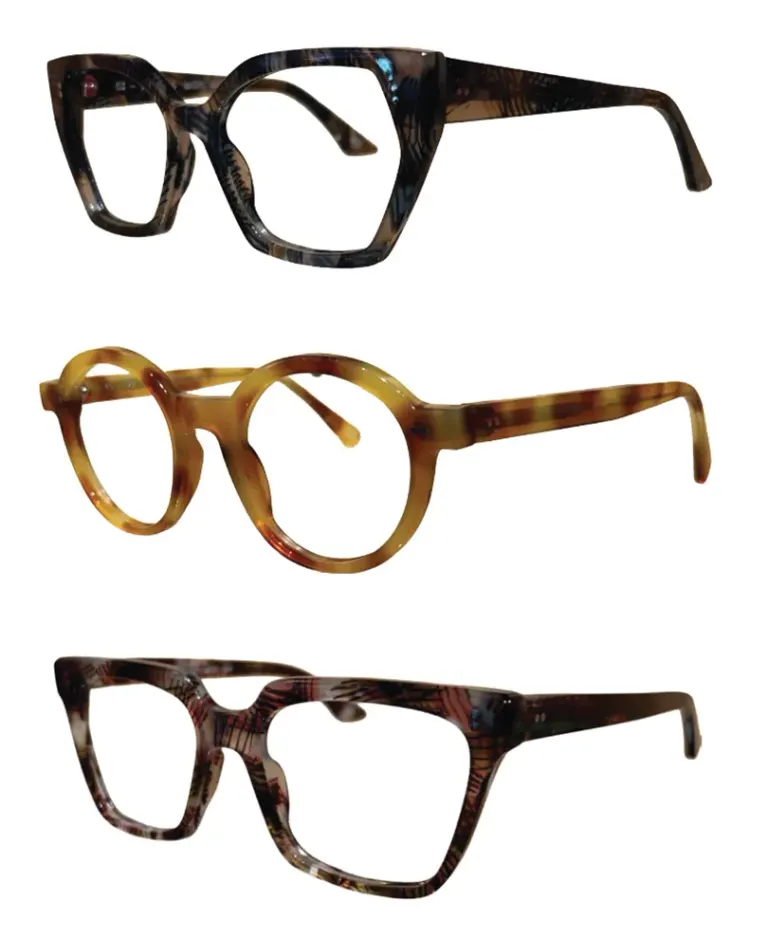
The aesthetic naturally leans toward classic shapes, but Mastel does not limit himself to reproducing the past. Some designs begin with familiar silhouettes and acquire new proportions or details. Others start with an idea he has not seen elsewhere and are tested to determine whether the shape works on a human face.
His process has evolved substantially since the first frame.
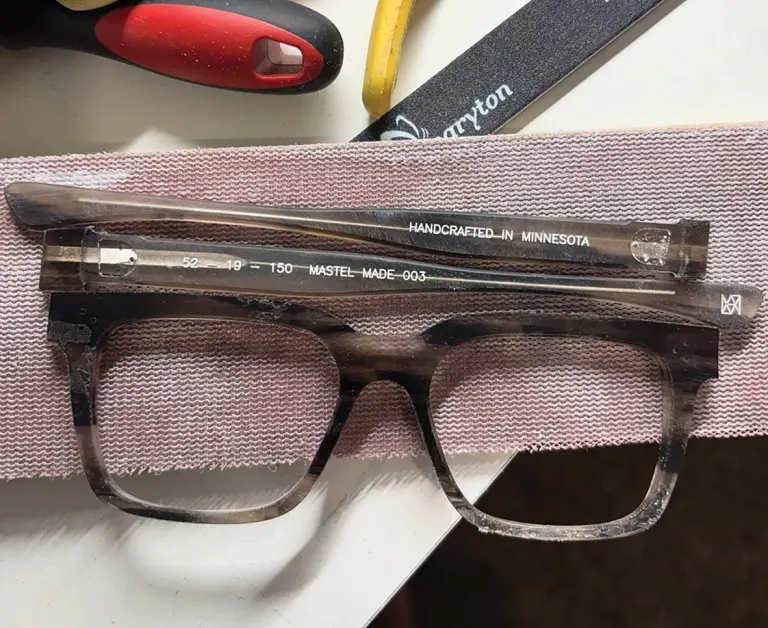
Early frames were cut and shaped by hand at the bench.
In the beginning, virtually every operation was performed manually. Mastel used a saw to cut the shape, formed the groove that would hold the lenses, and engraved the frame by hand. The result carried the unmistakable marks of handwork, but the method was too slow and imprecise to support a repeatable collection.
Today, machinery helps him cut the general form accurately. The remaining shaping, finishing, assembly, and customization are completed by hand. It is not a rejection of technology but a deliberate division of labor where machines provide consistency where consistency matters; the maker supplies judgment everywhere else.
That combination is also how Mastel Made describes its work publicly: locally handcrafted eyewear produced with a mixture of old and new techniques and fitted to the wearer's features and style. The Guild of American Spectacle Makers lists Mastel Made among its affiliated bespoke and small-batch makers, a community organized around independence, personal artistry and enduring quality.
Buffalo Horn, Horsehair and the Freedom to Experiment
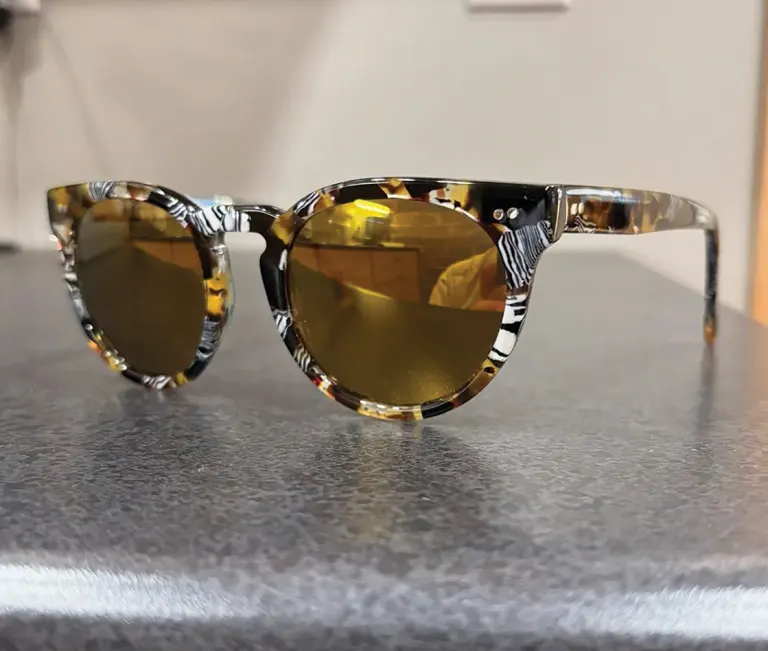
Pattern and color are part of the design too.
Mastel still has his earliest frame, packed away as a reminder of how far his work has progressed. But the first pair he remembers being truly proud of was made from buffalo horn.
Horn has a long history as a luxury eyewear material. Mastel made the pair for himself and still wears it occasionally. The finished frame was distinctive and successful; the production process was another matter. The material required extensive labor, and the smell created while working it was memorable enough that he has no immediate plans to make another in the new downtown space.
His most unusual commissions involve an even less expected material: horsehair.
The idea emerged while working with a client who was deeply involved with horses and wanted a personal keepsake. Mastel had once seen another maker incorporate hair into a frame and proposed trying it. The process is painstaking. The strands must be intentionally positioned, embedded in the material and allowed to cure. The result does not immediately announce itself as horsehair. From a distance, Mastel said, it resembles an organic ink pattern flowing through the frame.
Only after someone learns what it contains do the lines resolve into something recognizable.
He has completed several horsehair frames for the original client and another for a fellow horse enthusiast. Depending on the complexity, such a commission can cost around $1,000, a significant price, but still modest within the rarefied world of fully bespoke, labor-intensive eyewear.
Two Studios, One Family Business
Although Sean is the frame maker, Mastel Made is closely connected to the rest of the family.
Angela spent approximately a decade working as an optician and can contribute practical knowledge about fit and eyewear. She is also an artist who works under the name A.J. Mastel. Her side of the new studio is expected to host art classes, while her creative influence will extend into the design of the retail space next door.
"I'm the dreamer," Sean said. "She brings me down to reality."
Their differences are useful, but combining a marriage with business requires discipline. Mastel's advice for couples considering the same arrangement is to develop the ability to distinguish criticism of an idea from criticism of a person.
There will be difficult conversations. A spouse may reject a design, question an expense, or point out a flaw. For the relationship to withstand the business, both people must understand that disagreement can come from a shared desire to protect the work, not from a desire to hurt one another.
"You have to realize it's coming not from a relationship aspect, but a business aspect," he said.
Creativity runs through the household. Their daughters draw and make art, and their older daughter recently won an art contest.
Going All In
Leaving a secure position to build an independent shop introduces risks that cannot be eliminated through careful measurements.
Mastel must produce enough inventory, finish the retail space, attract customers, and turn a specialized craft into a sustainable full-time business. Angela was maintaining her full-time job while the studios took shape, providing stability as they made the transition.
Sean described the moment as "Scary, but exciting."
Yet the move is also the logical conclusion of his career.
The pharmacy student found a field that united technical knowledge, health care, design, and hands-on work. The lens specialist became a frame maker. The basement workshop developed into a collection. The collection earned space in an optical store. Now the maker is opening a place of his own.
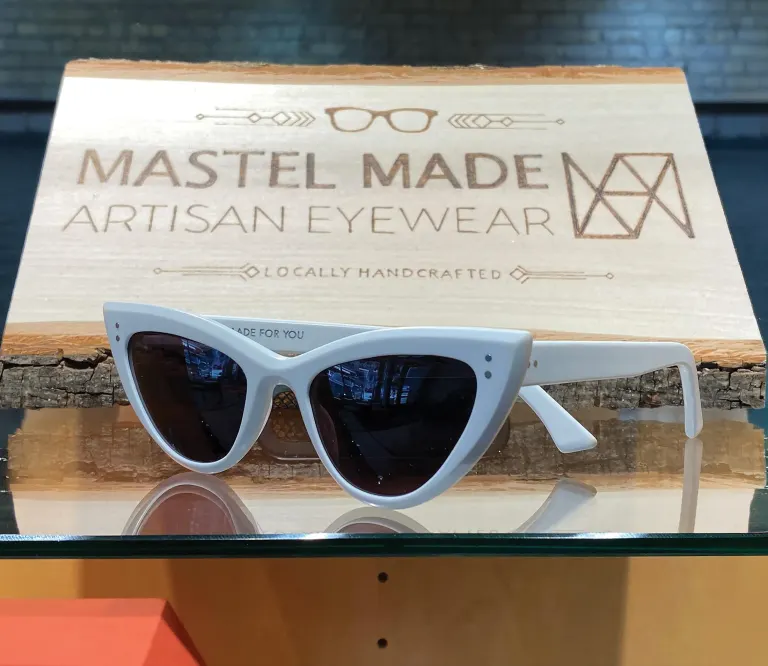
Mastel Made frames are locally handcrafted, and "made for you" is the idea.
What Mastel is building downtown is not a conventional optical shop and not quite an art studio. It is both: a place where the prescription matters, the proportions matter, the hinge matters, and the person wearing the finished object matters most of all.
The goal is not to persuade customers to own more frames. It is to make a frame worth keeping.
For Mastel, "made to last" is more than a design preference. It is the entire business plan.
Editor of Fargo INC! — covering the founders, companies, and ideas shaping business in Fargo-Moorhead. Eleven years in, still no opinions, no politics, all business.