Kevin Biffert: The Engineer Teaching Cattle to Talk · Fargo INC!
Businesses
Kevin Biffert: The Engineer Teaching Cattle to Talk
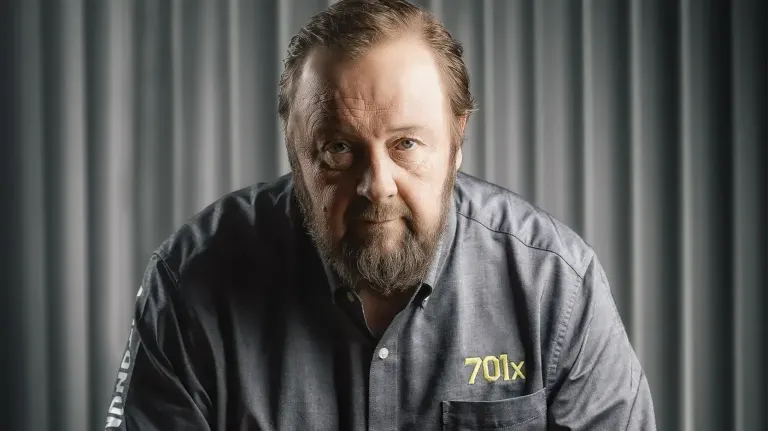
Kevin Biffert spent decades building precision manufacturing equipment before turning that expertise toward cattle. His company, 70ix, makes GPS ear tags designed to give ranchers an early warning system for their herds.
In shortEngineer Kevin Biffert, who previously built and sold pharmaceutical automation company Fargo Automation, founded 70ix in March 2020 to make GPS satellite-connected cattle ear tags that alert ranchers to health, location, and breeding changes.
3 things to know
1Biffert sold his prior company, Fargo Automation, to Germany-based Körber in January 2017; at sale it had ~80 employees, growing to 130+ under Körber within a year.
2In late 2024, 70ix acquired DigitalBeef, a registry platform with more than 9,000 ranches registered, to connect ranch-level data with breed association records and genetic information.
Generated by Claude · grounded in this articleNever used on sponsored content
By Brady Drake | Photo by J. Alan Paul Photography
Kevin Biffert: The Engineer Teaching Cattle to Talk
Inside 70ix's downtown Fargo headquarters, the ear tag is only part of the story.
There are 3D printers creating prototypes, laser-engraving equipment marking devices, and custom-built machines designed to simulate the impact, stress, and abuse a tag will encounter on a living animal. Increasingly, there are also robots automating the production process itself.
It looks less like a conventional agricultural startup than an advanced manufacturing laboratory, because Kevin Biffert has spent most of his professional life building machines that do things other machines cannot.
Only now, the machine goes on a cow.
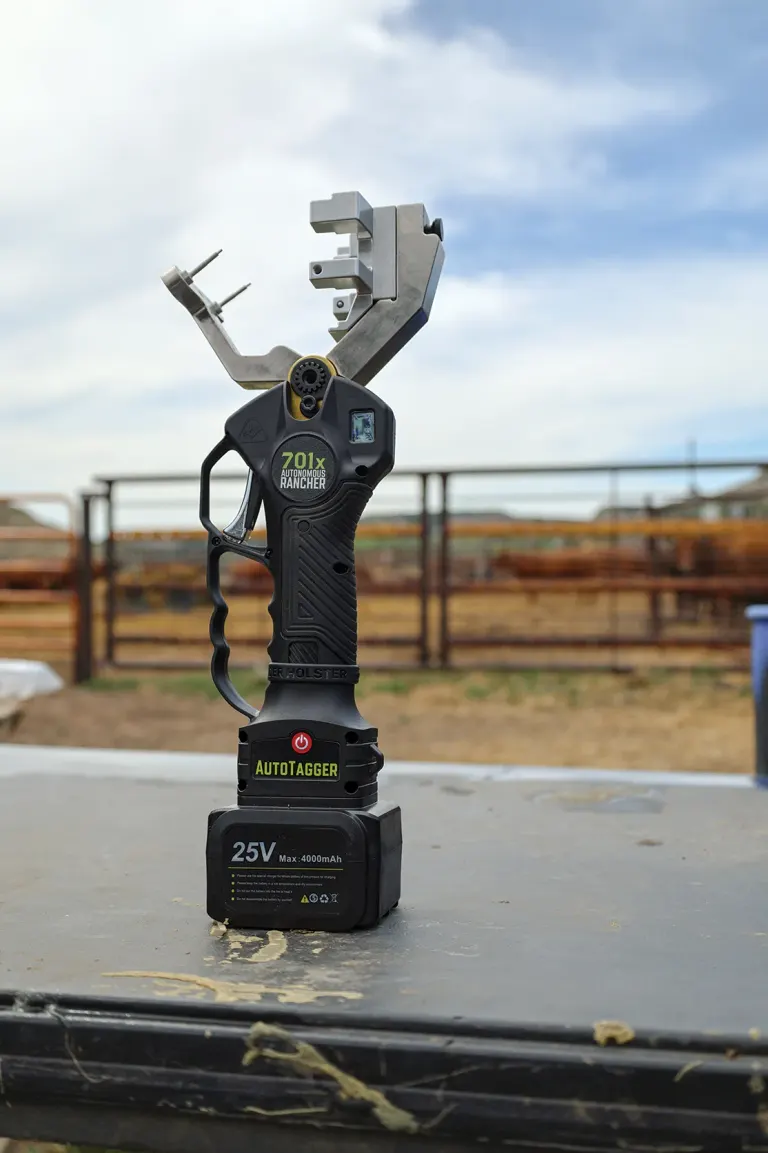
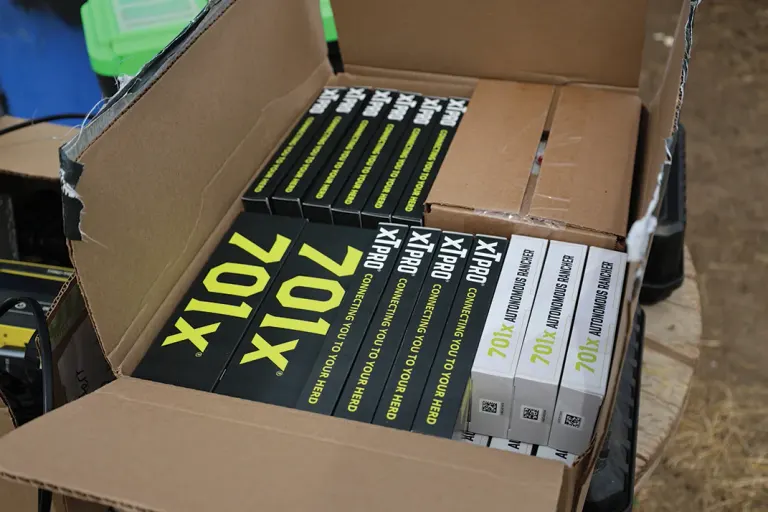
The company's flagship xTpro is a solar-powered GPS ear tag capable of communicating directly through satellite networks. It can alert a producer when an animal leaves a designated area, slows down in a way that may indicate a health problem, or exhibits changes connected to breeding and calving. It is designed to work without a rancher installing antennas or base stations across the property.
"Cattle don't talk," he said. "They actually try to hide their illness from you because you're a predator."
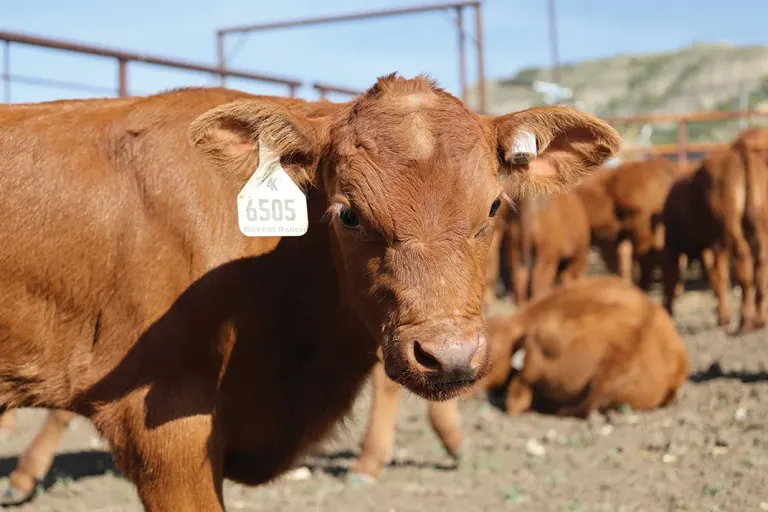
A cow cannot tell its owner that it has stopped feeling well. A calf cannot explain that it has become separated from its mother. A bull cannot report that it has crossed a fence, stopped breeding, or developed a respiratory problem.
70ix is attempting to give those animals a voice by helping the rancher notice sooner.
The tag does not diagnose a cow with pneumonia or prescribe a treatment. It detects changes in movement, activity, and behavior that may warrant a closer look. The producer still makes the decision. What 70ix automates is the act of noticing.
When everything is normal, the system is supposed to remain quiet.
"We collect data, but we don't do anything," Biffert said. "If a cow gets in trouble, gets sick, or gets out of the fence, then we start sending notifications."
Built to Fix What Breaks
Biffert grew up west of Killdeer, ND, as the middle child in a family of 15 children. Seven siblings were older, and seven were younger. The family primarily farmed, but it also kept roughly 40 to 50 cattle and five dairy cows.
There were enough children to milk all five cows by hand at the same time.
There were not many extracurricular activities. There were chores.
Trips to town required planning, and a trip to Dickinson for parts could mean traveling another 35 or 40 miles. If something broke, the family did not immediately replace it. They found a way to repair it.
"You had to do what you had to do to make it work," Biffert said. "Every day, you had to be resourceful."
That mindset became even more important during his senior year of high school, when his mother died after battling cancer. Biffert remained on the farm to help his father and younger siblings before leaving for North Dakota State College of Science in Wahpeton.
His formal education began in instrumentation and electrical technology. After graduating, he went to work at 3M in Wahpeton, maintaining, installing, and programming manufacturing equipment. He continued studying engineering through the University of North Dakota while working full time.
"Online" education looked different in the early 1990s. Lectures arrived on recorded video. Tests came through the mail and were completed under supervision in the company's human resources office.
In 1996, restructuring at 3M gave Biffert the opportunity to take a severance package. He used it to start Fargo Automation.
He did not begin with a breakthrough product or a roster of global customers. He began by offering to automate whatever local manufacturers needed automated. An early relationship with a Minnesota window manufacturer led to machinery projects, and his experience working with high-speed equipment in clean-room environments eventually opened the door to medical-device and pharmaceutical companies.
A 20-Year Apprenticeship
Fargo Automation found its niche in the handling and packaging of medical products, particularly glass syringes.
The machines had to be fast, precise, and reliable. Some eventually handled hundreds, and, in certain applications, more than 1,000 syringes per minute.
But technical capability did not immediately produce an easy business.
Biffert said it took nearly a decade for Fargo Automation to become consistently profitable. Each custom machine represented a leap of faith for the customer. A pharmaceutical company might place a multimillion-dollar order, pay a substantial deposit, and then wait a year or more for a one-of-a-kind system to be engineered and assembled.
The relationship was built less through dinners or golf outings than through execution.
You show up, and you do what you say you're going to do. That's what an engineer gauges you on.
The company also lived through the volatility of the capital-equipment business. Orders slowed after the 9/11 attacks. During the recession that followed the 2008 financial crisis, a backlog initially insulated Fargo Automation, but the downturn eventually forced the company to reduce its workforce dramatically. When customers resumed investing in equipment, the company rebuilt almost as quickly as it had contracted.
Those cycles taught Biffert the difference between building someone else's machine and owning a product of his own.
As a contractor, Fargo Automation received an order and designed a system around a customer's requirements. With a product company, Biffert could control the design, retain the intellectual property, refine the manufacturing process, and sell the same underlying solution repeatedly.
Fargo Automation became an internationally recognized builder of pharmaceutical manufacturing equipment. Biffert sold it to Germany-based Körber in January 2017. At the time of the transaction, the Fargo operation had approximately 80 employees; by the following year, Körber had moved its North American headquarters to Fargo and expanded the local workforce beyond 130.
Biffert left with capital, decades of manufacturing experience, and a persistent interest in the Internet of Things, the growing network of physical objects capable of collecting information and communicating remotely.
What he did not yet have was the right object.
The Idea Before the Idea
Before turning to cattle, Biffert worked on a system for managing floodwater across the Red River Valley.
His concept involved wirelessly controlled devices positioned at culverts. By selectively holding and releasing water across fields, ditches, and other drainage areas, the system could theoretically reduce the volume reaching the river at any one time. Biffert developed prototypes and patented a remotely operated flood-control architecture built around communicating gates and centralized control.
The project did not receive the support necessary for large-scale deployment.
But the architecture survived.
A rugged device would sit far from its user. It would collect local information, communicate through an unreliable or intermittent network, and allow someone to monitor conditions from a central screen. The system would need to operate with little maintenance, in severe weather, across an enormous geographic area.
In hindsight, the conceptual distance between an intelligent culvert and an intelligent cattle tag was not especially large.
Biffert's family members who remained in ranching had also been giving him a problem to solve with cattle crossing fences and disappearing into neighboring pastures or large tracts of public land.
In March 2020, Biffert started 70ix. Max Cossette, the company's first employee and now its chief financial officer, began interviewing cattle producers about the problems that consumed their time and cost them money. The team soon learned that location was only the beginning. Ranchers also wanted help with health, breeding, calving, recordkeeping, and infrastructure.
Engineers were hired later in 2020, software development followed, and 70ix's first ear tag became commercially available nationwide in May 2022.
Building an Ecosystem, Not a Tag
Biffert does not describe 70ix as an ear-tag company. He describes it as an ecosystem.
The xTpro is the most visible part. It provides GPS tracking and can generate alerts associated with fence boundaries, activity changes, estrus, calving, and bull mounting behavior. Its direct-to-satellite connectivity is designed for the places where cattle live, but cellular networks often do not.
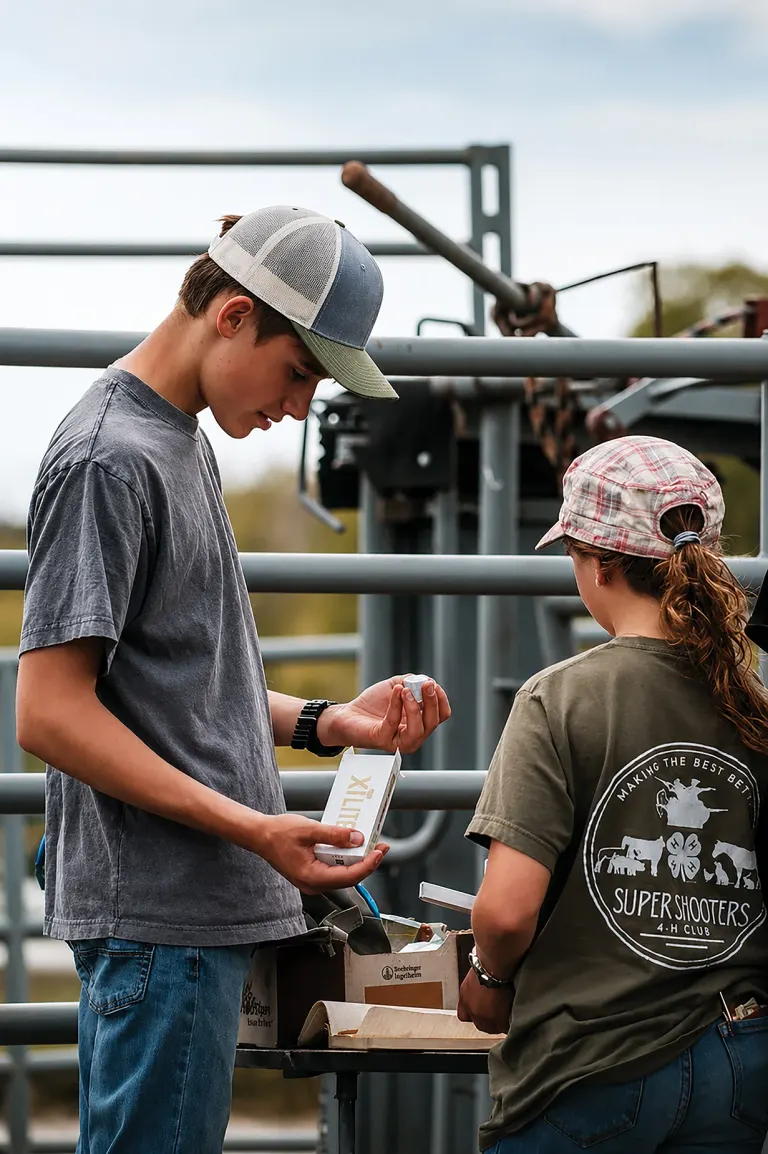
The smaller xTlite is designed for calves and broader herd coverage. It can contribute information related to calf activity, nursing, and separation from the mother. The company also offers xWatSen, a remote water-tank monitor intended to reduce unnecessary trips while alerting producers to water-level or temperature problems.
All of it connects to 70ix's cattle-management platform. The app functions as a digital calving book and recordkeeping system, allowing producers to enter information in areas without service and synchronize it when connectivity returns. It can track breeding, pregnancy, medical, and financial records while giving multiple family members or employees access to the same information.
In late 2024, 70ix acquired DigitalBeef, a registry platform used by breed associations and thousands of registered cattle producers. The acquisition moved 70ix deeper into pedigree, performance and genetic information, giving the company a pathway to connect what happens on the ranch with the systems used to register and evaluate animals. North Dakota's Department of Commerce reported that DigitalBeef had more than 9,000 ranches registered at the time.
What began as a way to find an escaped cow is becoming an attempt to connect an animal's entire productive life, from genetics and birth through breeding, health management and sale.
70ix tests those ideas on its own western North Dakota ranch. Biffert said the operation has roughly 140 mother cows, giving the engineering team a place to expose experimental devices to cold, heat, mud, water, brush and the destructive creativity of cattle.
Bulls are particularly effective product testers.
"It has taken us up until this year to get to about 1% breakage or loss," Biffert said. "You would think it would be easy, but it's not."
The Hardest Problem Is Habit
The economic argument for livestock monitoring appears straightforward.
The United States had approximately 86.2 million cattle and calves at the beginning of 2026, including 27.6 million beef cows and just over 2 million bulls. The national herd remained historically tight, while USDA forecasts continued to reflect elevated cattle prices. A breeding animal can represent thousands, or, in the case of high-value seedstock, tens of thousands, of dollars.
Death loss is also expensive. The USDA's most detailed national death-loss study, based on 2015 data, estimated that nearly 3.9 million cattle and calves were lost in one year at a cost of approximately $3.87 billion. Most losses were attributed to nonpredator causes. The study is dated, but it illustrates the scale of the problem 70ix is targeting.
Biffert's pitch is that identifying one serious health problem, one missing animal, or one unproductive bull can pay for a monitoring system.
Yet adoption remains more difficult than the arithmetic suggests.
Ranchers have managed cattle without satellite-connected ear tags for generations. Losses that appear shocking to an outsider can become accepted operating assumptions. A new device also brings a new workflow, a subscription, another source of notifications, and the possibility that the technology will fail at precisely the wrong moment.
Biffert understands that trust cannot be engineered in a laboratory.
He learned the same lesson at Fargo Automation, where customers needed years of proof before placing larger orders. With 70ix, the challenge is amplified because the product must earn the confidence of both the producer and the animal.
That is why the company emphasizes devices that arrive registered and ready to use, an app that functions offline, and satellite connectivity that does not require producers to install an additional network across their property. It is also why 70ix continues bringing design, testing, and manufacturing under its own roof.
Biffert wants to control enough of the process that when something goes wrong, his team can solve it rather than wait for an outside supplier.
From a Local Experiment to a Global Company
The scale of 70ix now makes it more difficult to dismiss as an experiment.
In June 2026, the company announced the close of an oversubscribed Series B round exceeding $10 million. According to 70ix, the round contained no venture-capital or institutional investment; it was funded by individual investors from North Dakota and Minnesota, along with ranchers who use the company's products.
Including approximately $6 million initially invested by Biffert, 70ix says it has brought in more than $27 million. As of June, it employed 56 people, 44 full-time, with the remainder working part-time or as interns. The company also reported its first profitable month, even while directing most of its labor budget toward research and development.
Biffert's first company taught him how automation could reduce the cost of manufacturing at scale. At 70ix, the company says robotics and automated production have reduced the assembly cost of the xTpro by 75%.
That matters because Biffert sees price as one of the largest remaining barriers to widespread adoption. Producing 20,000 tags is one business. Producing 2 million is another. Higher volume would allow 70ix to negotiate differently with suppliers, automate more of the process, and lower the cost per device.
The company is already operating in Canada and has announced plans to enter Australia, New Zealand, Mexico, the United Kingdom and Brazil before the end of 2026. Its research priorities include a rebuilt registry platform and a feedlot-management system focused on identifying health problems among animals in large, concentrated populations.
Biffert has said his long-term ambition is to take 70ix public. He views public capital not simply as an exit, but as a way to fund the scale of research, production and international expansion he believes the cattle industry will require.
Giving Ranchers Their Time Back
The most important return 70ix promises may be harder to place on a spreadsheet.
Biffert believes technology helped row-crop farmers dramatically increase the number of acres they could manage. Larger equipment, automatic steering, precision application, and better data allowed fewer people to accomplish more work.
Ranching has not experienced the same transformation.
A cow still calves at 2 a.m. Water systems still fail on holidays. Bulls still cross fences. A sick calf still needs a human being to find it, diagnose it, and administer treatment. Producers can improve efficiency, but they cannot schedule the needs of a living animal.
That reality affects who is willing to continue ranching.
Biffert said younger producers do not necessarily want to work the 90-hour weeks their parents accepted. They want to attend their children's games, leave for a weekend, and take a vacation without wondering what is happening miles away in a pasture.
His goal is not a ranch without ranchers. It is a ranch where the human being does not have to be physically present every moment to know when attention is required.
"Someday it will be really hard to ranch without these tools," Biffert said.
On the farm where he grew up, Biffert learned to fix what was in front of him because the nearest replacement part might be 40 miles away. At 70ix, he is applying the same instinct at a different scale, building devices, software, and even the machines that manufacture them, all to close the distance between a producer and an animal.
Cattle still cannot talk.
But they move. They eat. They ruminate. They breed. They separate from the herd. They slow down when something is wrong.
Biffert believes they have been communicating all along.
Someone simply needed to build the machinery to listen.
Editor of Fargo INC! — covering the founders, companies, and ideas shaping business in Fargo-Moorhead. Eleven years in, still no opinions, no politics, all business.