Inside Chipp AI Fargo: The Business That Builds Itself · Fargo INC!
Businesses
Inside Chipp AI Fargo: The Business That Builds Itself
Two years after Chipp made branded AI chatbots accessible to small businesses, Scott Meyer is making a much larger bet: that AI can build software, run workflows and handle entire parts of a company, without asking business owners to become technologists.
In shortFargo-based Chipp.ai has evolved from a no-code chatbot builder into a platform for 'autonomous companies,' now offering done-for-you AI development that builds, deploys, monitors, and repairs software.
3 things to know
1Chipp now sits above AI models from Anthropic, Google, and OpenAI, acting as a configurable business layer rather than training its own foundational model.
2Meyer distinguishes jobs at risk—those centered on moving information—from roles requiring judgment, taste, trust, or human relationships, which he expects to persist longer.
Generated by Claude · grounded in this articleNever used on sponsored content
Photography by J. Alan Paul Photography and Andrew Stone Photography
Building a Business That Builds Itself
Two years is a long time in artificial intelligence. It is long enough for a startup's original pitch to sound like a description of another era.
In May 2024, when Fargo INC! first profiled Scott Meyer and Chipp.ai, the company was easy to explain. Chipp let a business create a custom AI assistant, train it on company knowledge, wrap it in its own branding, and share it with customers or employees. The company had roughly 2,000 unique users, and its most visible applications included lead generation, tutoring, strategy, and internal knowledge. That product still exists.
It is now the smallest part of the story.
Meyer reaches for an iceberg to describe what has happened since. The branded chatbot remains above the waterline, the familiar box where someone types a question. Beneath it, Chipp has been adding layers with agents that take action, workflows that run on schedules, systems that connect to company data and, now, autonomous developers that can build, deploy, monitor and repair software.
"We just keep adding stuff underneath," Meyer said.
He sees AI's business evolution in three stages. First came chatbots, which wait for someone to ask a question. Then came agents, which can complete tasks. Now, Meyer believes businesses are entering the autonomous stage, where a system can recognize that work needs to happen and begin without waiting for a person to prompt it.
That progression has changed both Chipp's product and its ambition.
Founded in 2023 by Meyer and technical co-founder Hunter Hodnett, Chipp now describes itself as a platform for building "autonomous companies." By July 2026, the company reported more than 22,000 builders, 125,000 AI agents, and 14 million conversations across those agents. Chipp entered this new phase with venture backing, having announced a $2 million seed round at an $11 million valuation in July 2025.
What Meyer is building is no longer simply a better chatbot.
It is an operating layer between a business and the growing number of AI models capable of doing its work.
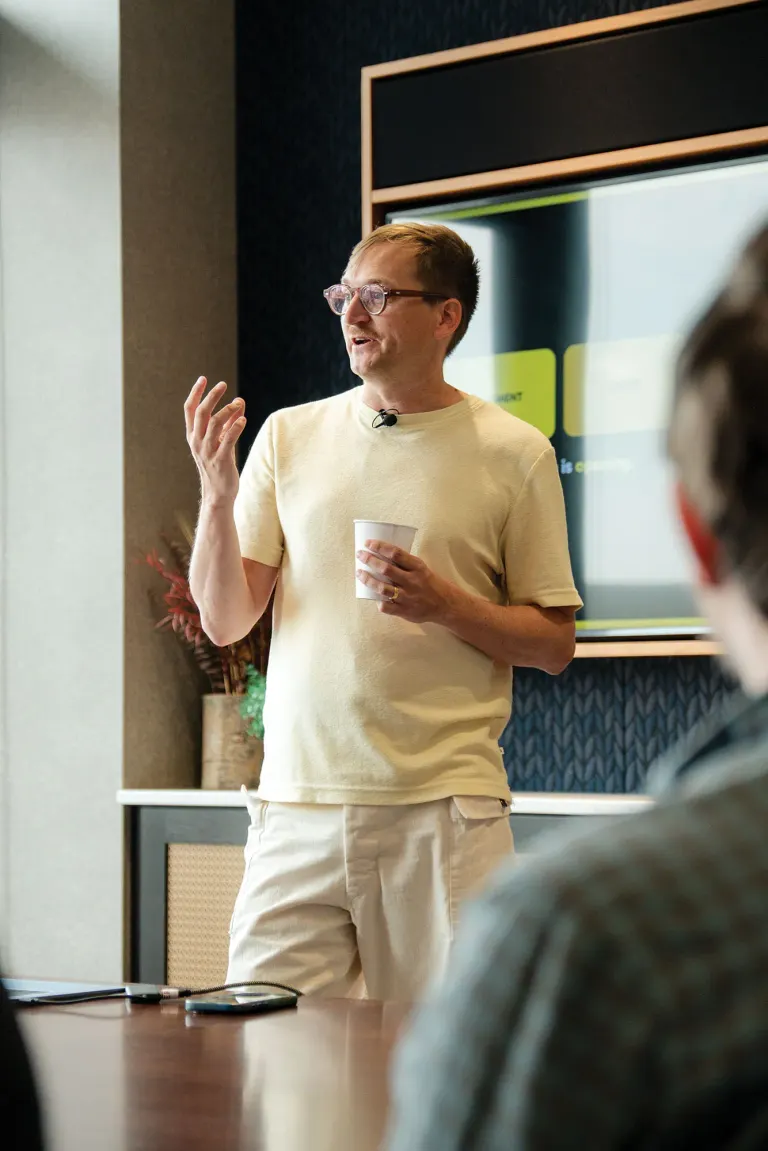
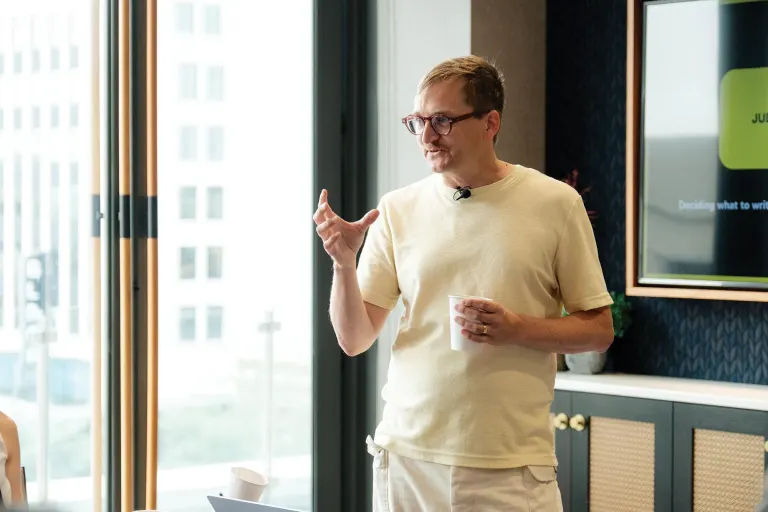
Chipp.ai co-founder Scott Meyer talks through where he sees AI heading for small businesses.
When I ask a question, I don't have to train it or upload files or create a project. It's already built for that specific use case." — Scott Meyer
The Layer Above the Models
Chipp does not train its own foundational AI model. It sits above models from companies such as Anthropic, Google and OpenAI, allowing a business to choose which "brain" fits a task while keeping its own workflow, data connections, rules and interface intact.
Meyer compares that layer to a harness.
A general-purpose AI tool works largely the same for everyone. The user must explain the situation, provide the right documents, define the desired outcome, and repeat much of that context the next time.
A Chipp application can be designed specifically for one logistics company, one clinic, or one agency. It already knows which information it may access, which steps to follow, which actions it can take, and when a person must approve the result.
That is also a pragmatic strategy for a company headquartered in Fargo. Chipp does not need to outspend the companies training the world's largest models. It wants to become the layer that makes those models useful inside a real business.
Meyer said the company currently processes about $130,000 a month in model usage across its customers. Chipp manages that access, gives customers an included amount of usage and charges for additional consumption on top of a platform fee.
The figure is less interesting as an expense than as a signal. The intelligence underneath Chipp is already beginning to look like a utility. The business Chipp wants to own sits one layer higher.
The Three Stages of Business AI
Chatbots — A chatbot waits for a person to ask a question. It can provide information, draft content, or help someone think through a problem, but the interaction begins with a human prompt.
Agents — An agent can perform a task based on a schedule or trigger. It might prepare a report every Monday, update content, or complete another recurring process without requiring a new prompt each time.
Autonomous systems — An autonomous system continuously monitors what is happening and initiates work on its own. In software development, that could mean recognizing a bug, attempting a repair, and escalating the problem only when human judgment is required.
No-Code Was Not the Finish Line
Meyer has spent much of his career translating new technology for people who do not live inside it. He co-founded the digital marketing agency 9 Clouds before moving into entrepreneurship and higher education. He later taught emerging technologies to developers and built FiveMin.AI around helping ordinary people put artificial intelligence to practical use.
Chipp's original mission, "AI for All," fit that pattern. But the meaning of access has changed.
In 2024, access meant no-code — give a nontechnical person an easy builder and let that person create the tool. As Chipp expanded from chatbots into agents, integrations, and software, customers started giving Meyer a different answer.
"They just want it done," he said.
A business owner may be capable of prompting an application into existence. That does not mean the owner wants to spend days learning a platform, testing edge cases, connecting data, and preparing the application for employees or customers.
Increasingly, Chipp is doing that work for the customer. Its team builds and launches the system, then hands it back so the company can operate, maintain, and improve it through conversation.
"They want to get it live and then maintain it with prompting rather than starting from scratch," Meyer said.
This "done-for-you" model is more than a service add-on. It corrects one of the technology industry's favorite assumptions, which is that making a tool easier to use means everyone will want to become a builder.
Most people do not want to build AI. They want the proposal sent. They want the patient followed up with. They want the data reconciled, the report updated, the customer answered, or the software fixed.
The next step in making AI accessible may be removing the building step entirely.
Meyer is also candid about where Chipp does not add much value. For a solo user handling one-off tasks, he recommends a general-purpose tool such as Claude or ChatGPT.
"If it's just you trying to do stuff, I would just use Claude or ChatGPT," Meyer said. "Chipp is better for a team than one person."
Meyer spends his days monitoring Chipp's agents, then onboarding customers, taking sales calls, and running demos.
The Six-Week Rebuild
His role has shifted toward oversight, exceptions, and growth.
Each done-for-you customer has a Slack channel. Chipp's agents work inside those channels, and Meyer monitors them for stalled tasks, client requests, or new features that require approval. Around that triage, he handles onboarding, sales calls, and demonstrations.
His workday sounds less like managing a conventional software department and more like directing air traffic: watch the systems, intervene when judgment is required, and keep new business moving into the network.
"I kind of have this hovering on the side," Meyer said. "Then I'm doing a lot of onboarding and sales and demos."
This is the distinction Meyer wants businesses to understand. Autonomy does not necessarily remove people from a company. It changes where they spend their time.
The machine handles more execution. The human decides what deserves to be built, which tradeoffs are acceptable, and when the system should stop.
The clearest customer example is Valor Victoria, a West Fargo logistics company that helps move intermodal freight and gives customers visibility into containers as they travel from ports to rail lines and inland destinations.
In that world, predictability has a price. Air freight can deliver quickly and reliably, but rail is significantly less expensive. The challenge is knowing where a container is, where it may be delayed, and whether it will reach its destination on time.
Valor Victoria built its business around bringing order to that uncertainty, coordinating inland shipping and giving customers better visibility into their supply chains. The company had also built software to organize that complexity.
According to Chipp's published case study, Valor Victoria's previous platform took three years and $1.2 million to build. Chipp's autonomous development system rebuilt the foundation of Valor Victoria's platform in approximately six weeks. The company has continued refining the system in the months since, progressively transitioning operational workflows from manual processes toward AI-assisted and autonomous execution. The shift has allowed Valor Victoria to reduce its engineering operation from nearly 20 developers to one.
The transformation also produced significant financial efficiencies, dramatically reducing the resources required to develop and maintain the platform.
For Meyer, Valor Victoria represents the ideal legacy-software customer: a company with an old, expensive, or unwieldy system that works well enough to keep but poorly enough to drain the business.
That does not make autonomous development universal.
Chipp's own materials say its Alchemist Cloud system currently builds web applications on a prescribed technology stack and requires access to usable data through an API, database or authenticated portal. It is not yet a fit for native mobile applications or projects contractually locked into another vendor.
The company also cautions that "self-healing" does not mean infallible. The system repairs what it can resolve safely and escalates judgment calls to a human engineer rather than guessing.
Those limits matter. The more work a system can do without asking, the more important it becomes to define where it must ask.
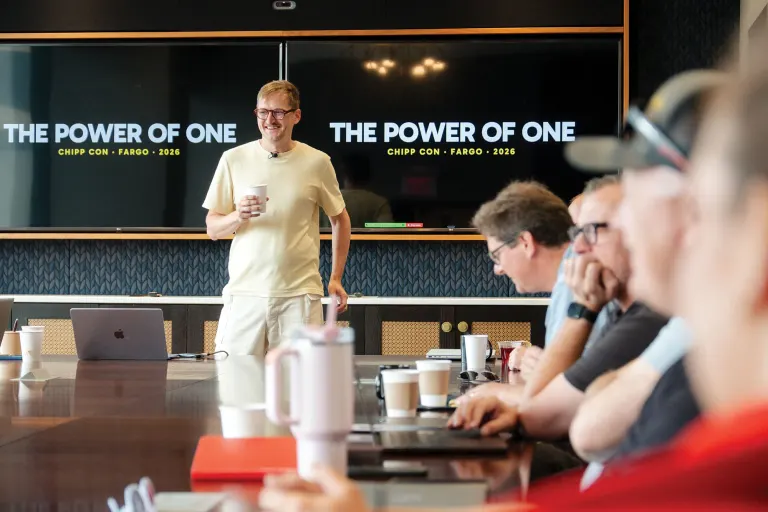
Meyer presents to a room at Chipp Con Fargo 2026.
Asking the "Business Brain"
Meyer describes one of Chipp's central concepts as a "business brain." Imagine a command center containing a company's financial results, sales activity, growth metrics, and operational data. Instead of opening several programs and assembling the information manually, a leader could ask a question such as: "Why did revenue increase yesterday?" The system could review the connected data, explain what changed, and allow the user to act on the answer. If an overdue payment affected the numbers, the leader could ask the system to send a reminder. If a sales opportunity stalled, it could create a follow-up task.
A Company You Can Talk To
Meyer often describes Chipp as a "business brain."
The idea begins with a command center, a dashboard that brings together performance, growth, and financial data.
Instead of opening separate applications and hunting for answers, a leader could ask, "Why did revenue rise 5% yesterday?" Chipp could analyze the connected data, explain what changed and then act on the answer, sending a reminder to an overdue customer, updating a forecast or creating a follow-up task.
"It's the conversation layer on top of everything else," Meyer said. "I can just talk to all this stuff in one place instead of having to jump around."
In healthcare, the same concept can begin with an audio recording of an appointment. The system can transcribe the conversation, draft a letter for a parent, prepare a referral note for a dentist and create structured information for the patient chart. One human interaction creates a waterfall of administrative work. The doctor or staff member can still review each output before it leaves the system.
Healthcare has become an important market for Chipp because the company offers security and compliance controls for regulated workflows. Its documentation says it holds business associate agreements for eligible Google Gemini and Anthropic Claude models.
HIPAA compliance depends on how a system is configured and used. Voice, transcription, memory, and other supporting services may involve different providers and require additional review. Turning on a compliance setting does not automatically make an entire workflow compliant.
That caveat is not a weakness. It is a reminder that "compliant AI" is a system-design question, not a button a company can press and forget.
Meyer recommends that customers begin with a person in the loop. Approve everything. Watch how the system behaves. Learn where it is dependable and where it needs better instructions. Then remove approvals selectively as trust grows.
You can decide how much human in the loop you want. Most people start by approving everything. Once they trust it, they let go of some of it." — Scott Meyer
Autonomy, in this model, is not an on-off switch. It is a series of decisions about how much authority to delegate.
Meyer says jobs built on moving information are most at risk, while work that requires judgment, taste, and trust will last longer.
The Work That Remains Human
Chipp's growth makes the question of workforce reduction impossible to avoid.
If a two-person company can produce the output of a much larger software team, and if a customer can reduce an engineering operation from 25 people to one, what happens to the work that disappears?
Meyer does not claim to know a company personally that operates with no employees. He also does not frame the change as every job vanishing at once.
He sees tasks separating from roles.
"If your job is to move information, either taking information up to the C-level or getting information from the C-level down to the team, that's where your job is at risk," Meyer said. "There's no need to have people help move information anymore."
The distinction he draws is between moving information and creating something that requires judgment, taste, trust, or human energy.
AI is already strong at code, numbers, summaries, and structured transformations. Meyer expects people to remain important longer in sales, where a buyer often wants another person to listen, react, and build confidence.
That line will continue to move.
Yet Chipp's own operating model suggests that the near-term future is not a company without humans. It is a company with fewer people performing repetitive coordination and more people handling goals, relationships, exceptions and judgment.
Those are not automatically easier jobs. They require a business to know its processes well enough to formalize them, and its values well enough to decide what should never be automated.
Four More Ways Businesses Are Using AI
Building proposals — Meyer described an agency using Chipp to pull information from sales conversations, prepare proposals, and return them to clients. The process became so fast that the agency began building in a delay before sending the proposals because an immediate response would reveal how heavily the work had been automated.
Creating personalized curriculum — TNT Fitness was beginning to use Chipp to develop curriculum for schools around the country, with material personalized to the students or needs inside a particular classroom.
Turning interviews into content — An interview recording can become more than an article transcript. The same conversation can be used to prepare and schedule social media posts across several platforms.
Running recurring workflows — An AI agent can prepare weekly reports, update content, copy edit material, or complete other recurring tasks based on a schedule rather than waiting for a person to initiate each assignment.
The Next Layer
Meyer believes every company will become autonomous in some form within the next 18 months.
For one business, that may mean an AI system reschedules appointments. For another, it may check billing, prepare proposals, monitor software, or run most of an operation with one person overseeing it.
Companies will choose different levels of autonomy, but Meyer believes nearly all of them will choose some.
Meyer's career has been one long exercise in translation, but his question has not: How do ordinary people and businesses gain access to capabilities that once belonged only to specialists?
In 2024, Chipp's answer was to let anyone build a custom chatbot. In 2026, its answer is more ambitious: let people describe the business, connect the data and decide the guardrails, then let the software build, act, monitor and repair.
That is a harder product to build and a harder promise to keep. It is also the bet beneath Chipp's familiar chat window.
For Meyer, "AI for All" no longer means everyone becomes a programmer.
It means fewer people have to.
The Chipp mascot, a yellow character with a coffee cup, on a water bottle.
See what it looks like to build with Chipp.
FAQ
Q: What does Chipp do? A: Chipp is a Fargo-based AI platform that lets businesses build branded AI agents, and now offers "done-for-you" development that builds, deploys, monitors, and repairs software autonomously.
Q: Who founded Chipp? A: Chipp was founded in 2023 by CEO Scott Meyer and technical co-founder Hunter Hodnett.
Q: How much funding has Chipp raised? A: Chipp announced a $2 million seed round at an $11 million valuation in July 2025.
Q: What is Chipp's "business brain" concept? A: A conversational layer over a company's CRM, email, calendar, and financial systems that lets employees ask questions about the business and initiate work from the same conversation.
Editor of Fargo INC! — covering the founders, companies, and ideas shaping business in Fargo-Moorhead. Eleven years in, still no opinions, no politics, all business.