In shortHow a lake-house side project became one of the region’s most visible solar, battery, and energy companies.
3 things to know
1Ben Holsen did not set out to build one of the region’s most visible solar companies.
2Originally, he had a lake place—technically his parents’ lake house—and he kept looking at the roof, the sunlight, and the tax credits available at the time.
3Holsen had always been interested in alternative technologies.
Auto-summary · grounded in this articleNever used on sponsored content
Read this feature in the June 2026 issue of Fargo INC!
Ben Holsen did not set out to build one of the region’s most visible solar companies.
Originally, he had a lake place—technically his parents’ lake house—and he kept looking at the roof, the sunlight, and the tax credits available at the time. Holsen had always been interested in alternative technologies. He liked taking things apart, figuring them out, and putting them back together. Solar seemed like one of those things.
There was only one problem.
“I wanted solar panels at my lake house, and I couldn’t find anybody around that would do them,” Holsen said. “So I ended up just kind of figuring out how to do it myself.”
That project, completed roughly eight or nine years ago, became the unlikely beginning of Holsen Solar.
It was not perfect. There were, as Holsen put it, “some speed bumps” that come with stepping into something new. But the system worked. More importantly, it revealed a gap in the market. If he wanted solar and could not find someone nearby to install it, chances were other people in the Fargo-Moorhead region, across North Dakota, and into western Minnesota were running into the same problem.
So he did what entrepreneurs tend to do when they solve a problem once.
He added it to the website.
At the time, Holsen was already doing camera systems, networking, and other technology-related work as a side hustle. Solar became one more service listed on the site.
How Long Do Solar Panels Last?
Solar is often a long-term investment. The U.S. Environmental Protection Agency says solar panels typically have a 25- to 30-year lifespan. The Department of Energy similarly notes that photovoltaic systems commonly have 20- to 30-year lifespans, while newer industry surveys suggest average operational lifespans have grown to 25 to 35 years.
One project followed. Then a couple more. Then a couple more after that.
“It slowly kind of took over as the primary source of the business,” Holsen said.
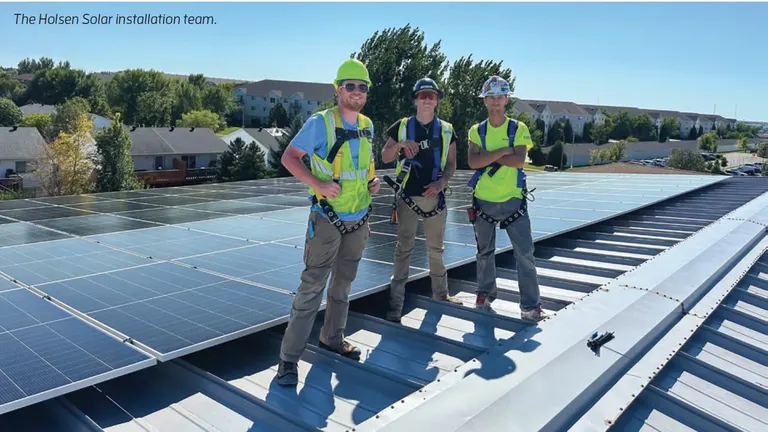
Today, Holsen Solar has grown from that first experimental lake-home installation into a 15-person company serving homeowners, farms, commercial clients, and organizations across the region. What started as a side project now includes solar installation, battery storage, EV charging, electrical work, permanent lighting, and other energy-related services.
The path was not linear. It was not traditional. And Holsen will be the first to say he probably entered the industry backwards.
“I’m not an electrician,” he said. “I never was an electrician. I was dealing with something that required an electrical license, so I was kind of going in as a consultant, getting electricians to come in for us and stuff. It was an interesting path to get here.”
That path, however, makes sense once you understand Holsen.
He is not just a solar contractor. He is a lifelong tinkerer, a tech entrepreneur, and someone who has never been particularly comfortable accepting the standard way of doing something if he can see a better one.
“If I’m told to do something, and I find a better way to do it, I want to do it that way,” Holsen said. “A lot of times, they don’t want you to do it that way. Just stay in process. Stay the course. That just doesn’t work well for the way that I function.”
A Business Owner Since Sixth Grade
Holsen has wanted to be an entrepreneur since he was about 10 years old.
In sixth grade, when the first Iraq War broke out, he made little yellow ribbons and sold them at school. It was not some accidental childhood hustle. Even then, he understood that he wanted to own a business someday.
“I’ve been a serial entrepreneur kind of my whole life,” he said.
Technology was the obvious lane. Holsen was into computers from a young age, and after college, he went to work for a Fargo company that, improbably, owned one of the largest Usenet companies in the world.
Usenet, for those who never lived in that corner of the internet, was a massive network of online newsgroups and bulletin boards. Before social media made the internet feel centralized and polished, Usenet was one of the places where people traded information, files, conversations, and communities.
The company Holsen worked for had only a handful of employees but served hundreds of thousands of customers. Because it was small, he was able to move up quickly. While there, he and another employee noticed a need for privacy and security among users of news feeds. That led them to start a VPN company called Secure Tunnel.
At the time, VPNs were still largely thought of as corporate tools—something an employee might use to connect to a work server while traveling. Holsen and his partner saw another use case: using a VPN to encrypt traffic, protect identity, and change the apparent location of a user.
“That was kind of way ahead of its time,” Holsen said. “We were one of the first VPN companies using VPN in that type of way.”
They ran that company for 15 years.
He has also tried other ventures, including a cell phone charging locker system for bars—a concept that was difficult to make work financially at the time but is now common in places like Las Vegas, event venues, and high-traffic entertainment areas.
“We were just kind of ahead of the curve a little bit,” Holsen said.
That pattern has repeated throughout his career. Holsen often sees where technology is going before the market is fully ready for it. Sometimes that means being early. Sometimes that means having to build the market yourself.
Solar was another version of that.
“I don’t think that I would have the opportunity to be in this world unless I created it myself,” he said.
There are only two solar companies in all of North Dakota.
The Big Iron Turning Point
For the first few years, solar grew gradually. Then Holsen took the business to Big Iron.
About four years ago, he began advertising to farmers at the Big Iron Farm Show. At the time, there were strong grant opportunities available for rural energy projects, particularly through the Rural Energy for America Program, commonly known as REAP.
The program could cover up to 50% of the cost of qualifying renewable energy projects for farmers and rural businesses. For farm operations with grain bins, shops, barns, and other energy-intensive infrastructure, solar could make real financial sense.
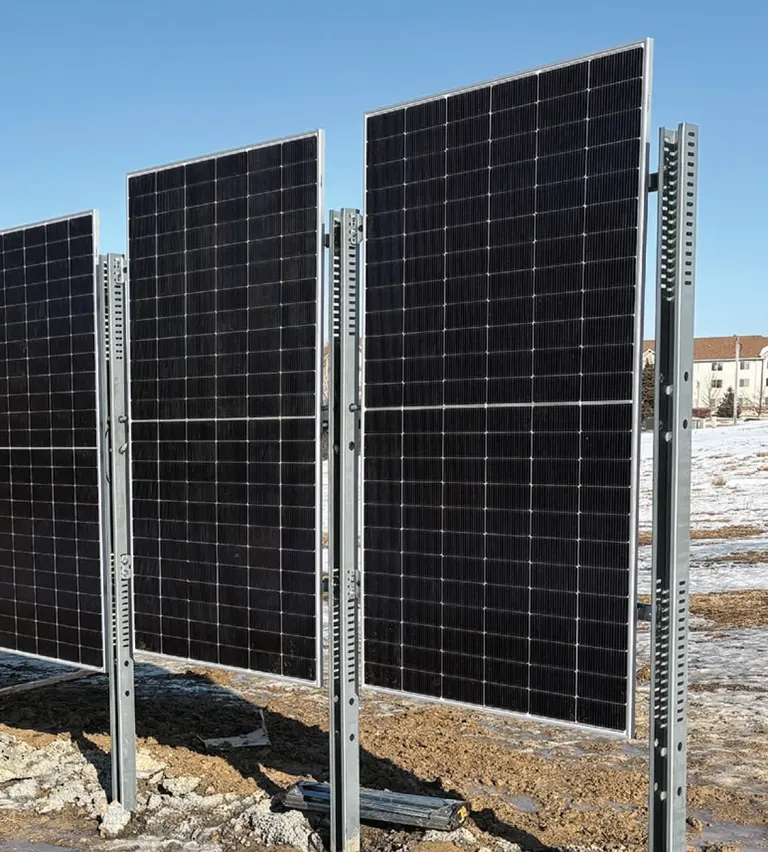
A ground-mounted solar array installed by Holsen Solar.
That year, Holsen said, the company sold roughly 10 large projects.
“That’s really where things started to take off,” he said.
These were not utility-scale solar farms covering fields and fields of land. The projects Holsen Solar was building were practical, operation-sized systems designed to offset a farm’s own energy use.
“We’re not doing industrial scale,” Holsen said. “We’re doing things that would go on top of their pole barn. We’ll do 100 panels, 150 panels.”
The goal was not to turn farmers into power companies. It was to help them control one of their rising expenses.
“They were really helping farm operations,” Holsen said.
That agricultural work helped push Holsen Solar into a new phase. The company grew from five people to 15 in just over a year. It also began evolving from a solar installer into a broader electrical and energy company.
Solar Myths Holsen Wants to Clear Up
Myth 1 — Solar only works in hot places. Solar panels need sunlight, not heat. In fact, panels can become less efficient when they get too hot.
Myth 2 — Solar is always about maximum ROI. For some customers, the return is the primary reason to install solar. For others, the value is energy independence, predictable monthly costs, backup power, or environmental impact.
Myth 3 — Solar panels are dangerous or unhealthy. Holsen said he has seen strange internet rumors suggesting panels cause health problems. His response is that panels are primarily made of materials such as glass, silicon, aluminum, and wiring—the same broad categories of materials found throughout modern electronics and electrical systems.
A Market in Motion
The solar industry is changing quickly. For years, tax credits and grants helped drive adoption. Now, some of those incentives have changed, paused, or disappeared. According to Holsen, the REAP program, which had been important for farmers, went on hold at the start of the Trump administration. He also said the residential tax credit, which had been expected to continue through 2032, ended last year following federal legislation passed in July.
The commercial side, however, has become more attractive in some ways. Holsen said commercial projects still have a tax credit and now have access to 100% bonus depreciation, though businesses need to move before upcoming deadlines.
“The message probably for business owners is you’re going to want to do this if you can before this deadline,” Holsen said.
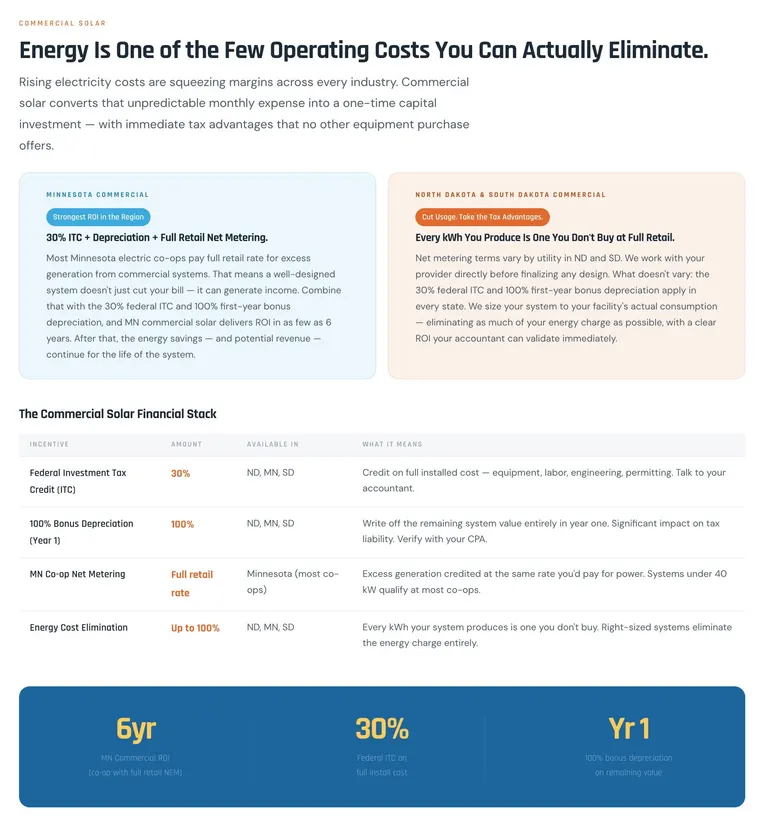
Holsen Solar’s breakdown of the commercial solar financial stack — the federal investment tax credit, 100% first-year bonus depreciation, and net metering across Minnesota and the Dakotas.
Even with incentives shifting, interest has not gone away. In some cases, it has increased.
Part of the reason is simply that energy prices are rising.
Holsen said he has seen power costs increase significantly, and he expects that pressure to continue as large energy users—especially data centers—place more demand on the grid.
“The price of energy is going up a lot,” he said. “The tax credit isn’t necessarily needed to make these projects now pencil out.”
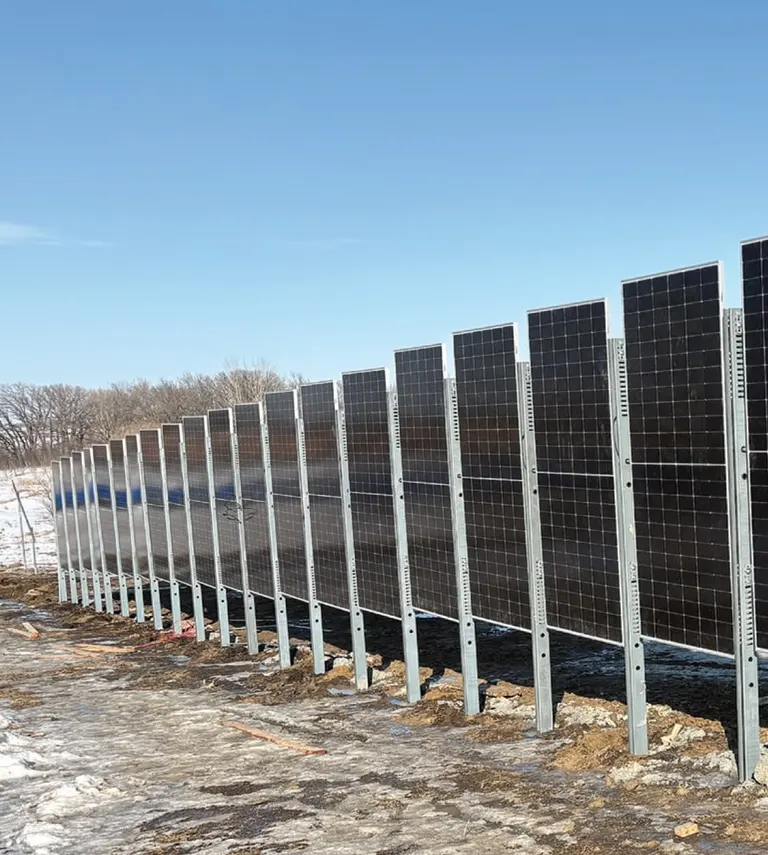
Ground-mounted solar panels installed by Holsen Solar.
The return on investment varies widely depending on the state, utility, project type, and whether the customer is residential, agricultural, or commercial. Minnesota, Holsen said, remains especially favorable.
In Minnesota, solar is like a fantastic deal.
“If you’re doing it for commercial in Minnesota, it’s almost a no-brainer, because you’re getting a return on investment of like five years,” he said.
North Dakota is more situational, but still compelling for the right customer.
“If you’re using the power and you can take advantage of the tax credit, and you’re in North Dakota, it’s a great deal still,” Holsen said.
Residential projects require more individualized analysis. Without the same tax benefits, payback periods are longer. Holsen does not pretend otherwise.
For a North Dakota homeowner, he estimated solar may carry a payback period around 10 to 13 years, depending on the project.
But Holsen also thinks ROI alone misses part of the value.
Solar, in his view, is also about control.
“You’re controlling the price of your power for your house,” he said. “If you want to stabilize your monthly expenses, you don’t want it fluctuating all over the place. If you put in solar, that helps you control how much power you’re generating.”
Solar, Batteries, EVs, and the New Energy Ecosystem
Battery storage adds another layer: backup power during outages, protection from potential grid instability, and the ability to store energy rather than simply produce it during daylight hours.
That is where Holsen believes the industry is getting especially interesting.
Three years ago, Holsen Solar was not installing many batteries. Today, Holsen said roughly half of the company’s projects involve battery backup systems.
That shift matters because it changes what solar can do.
For years, solar was often thought of as a grid-tied system. Panels produced electricity, the building used what it could, and excess energy was sent back to the grid. Batteries existed, but they were expensive and less integrated.
Now, Holsen said, solar, batteries, EVs, and energy management systems are beginning to merge into one connected ecosystem.
The whole ecosystem is starting to coalesce.
“If we take solar, and we take your EV, and we charge your EV with your solar, your EV can also power your house,” he said.
That is the kind of technological convergence that excites him most.
“It’s super fascinating to watch and super fascinating to be part of,” Holsen said. “You really feel like you’re on the cutting edge of technology.”
The battery market, in particular, has changed quickly. Holsen pointed to a home battery unit that would have cost around $10,000 three years ago. Today, he said, that same type of battery is around $4,000.
“The battery technology has come a long way, and the prices have really come down,” he said.
That price movement mirrors what already happened with solar panels. Panel costs have fallen dramatically over the past decade, while output has improved. The lake-home system that started Holsen Solar used 300-watt panels. Today, Holsen said he can get 440-watt panels in the same footprint and at a lower price.
The original system is still running.
“It’s working great,” Holsen said. “It’s been running for eight years, and I just don’t even really think about it anymore.”
Editor of Fargo INC! — covering the founders, companies, and ideas shaping business in Fargo-Moorhead. Eleven years in, still no opinions, no politics, all business.