In shortSales professional Neil Keltgen built Century Club, a structured men's fitness program using daily standards, a weekly Garmin-tracked scoreboard, and monthly team competitions to recreate the accountability of organized sports.
3 things to know
1Century Club operates on three rhythms: daily behavioral standards, a weekly scoreboard tracking Garmin data, and monthly strength competitions with live standings and team formats.
2Members who hit at least four of seven weekly benchmarks are considered to have won the week; those who repeatedly miss standards without engaging may be asked to leave.
3Keltgen started with four friends, grew to 17 members by the time of the interview, and deliberately slowed enrollment while refining the program and considering how to add another coach.
Generated by Claude · grounded in this articleNever used on sponsored content
On Century Club strength day, the rubber chicken has one job: expose a bad push-up. A member lowers his chest toward the floor. If the chicken does not squawk, the rep does not count. Nearby, a strength coach wearing a referee shirt watches for bent knees, incomplete movements, and the other small compromises people make when their muscles begin bargaining with them.
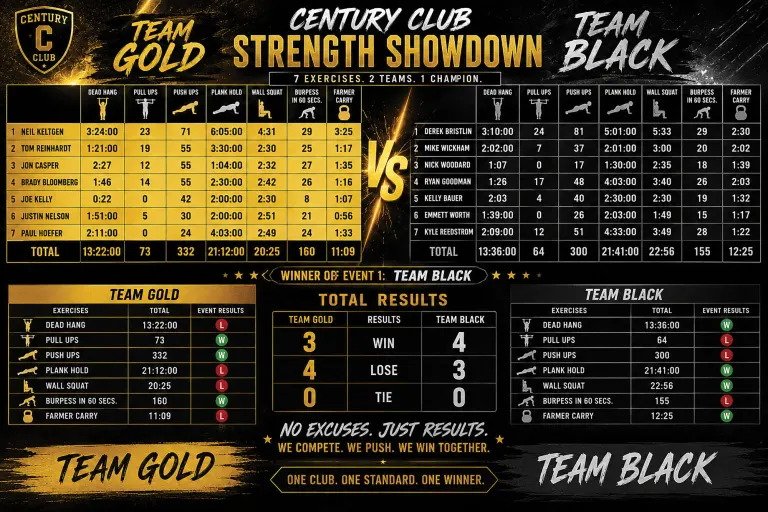
There are seven events in all, including dead hangs, pull-ups, push-ups, planks, wall sits, burpees, and ending with a farmer carry with 75-pound dumbbells. Members have been drafted onto teams. Results are entered into a live scoreboard. Points are awarded, standings change and trash talk fills the room.
Team Gold vs. Team Black on strength day
It is playful by design. It is also surprisingly serious. Before one competition, a member told Century Club founder Neil Keltgen that he had already made three nervous trips to the bathroom. He had not felt that way since high school football.
“That’s why it works,” Keltgen said. “We haven’t felt like that in years.”
By the next morning, the men were already thinking about the next test. They know how long they held the bar. They know how many pull-ups they completed. More importantly, they know somebody else is working to beat them.
That feeling, the return of the butterflies, may explain Century Club better than any fitness metric can. Keltgen did not simply build a workout program. He built a place for men who miss being on a team.
A sales guy builds a dashboard
Keltgen has spent his professional life in sales, an environment governed by targets, pipelines, performance reviews, and dashboards. He is also one of the contributors to Sales Hangover, a podcast in which sales professionals and managers discuss accountability, motivation and the fundamentals behind sustained performance.
Approximately three years ago, he began wondering why he was not applying the same thinking to his health.
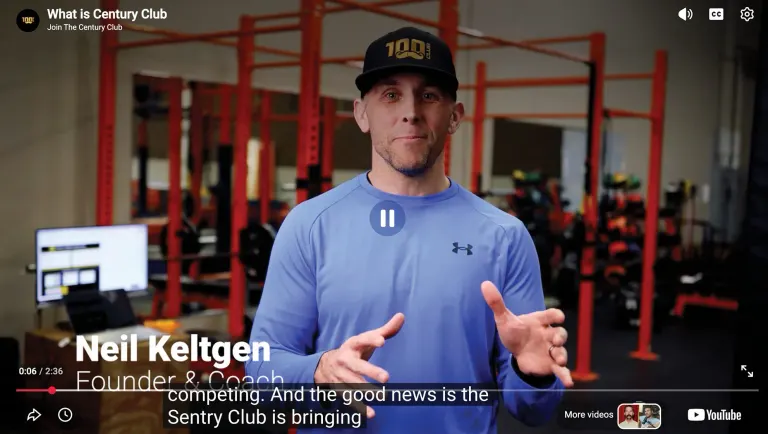
Neil Keltgen, founder and coach, in the club intro video
He opened a Google Sheet and started building a personal dashboard. He identified measurements he cared about in strength, cardiovascular fitness, and other areas, then began recording his results. It was not meant to become a business. It was simply an attempt to make health visible.
At the same time, Keltgen was becoming increasingly skeptical of the online longevity movement: the endless parade of optimization strategies, supplements, protocols and personalities promising that the right combination might carry someone to 100, 110 or 125. He was interested in aging, but not immortality.
He had begun looking differently at his parents, aunts, uncles, and other people around him as they grew older. The question was no longer whether he could add years to his life. It was whether those years would still contain the things that made life worth living.
“I don’t want to stop at 75,” he said.
From four friends to 17 members
Keltgen invited four friends to join him. His pitch was to get a Garmin watch, follow the standards, and let the group see what you are doing.
Then something unexpected happened. The four men began getting into noticeably better shape. Other people asked what they were doing. Those conversations produced phone calls from men who wanted Keltgen to work with them. A few even suggested that they should be paying him.
Eventually, he made a website and prepared to create a Facebook page. Keltgen had barely used Facebook in years and inadvertently published a promotional reel before realizing what he had done. He was walking on a treadmill when inquiries started arriving.
“I’m getting leads, and I’m in sales my whole life, and I’m like, ‘What do I do now?’” he said.
The program grew from four members to 17 by the time of the interview. Keltgen deliberately slowed enrollment while he refined the experience, identified gaps, and considered how another coach could eventually be brought in without weakening the culture.
Training in a 100 Club shirt
Century Club’s current website describes its first Fargo group, or “pod,” as full and says a second pod for men 37 and older is now opening.
The demand surprised Keltgen. The reason for it did not. The program gives men something many of them have been missing since organized sports ended: competition, accountability and teammates who notice whether they showed up.
Three rhythms: daily, weekly, monthly
Century Club operates on three overlapping rhythms: daily standards, a weekly scoreboard and a monthly competition. The daily standards cover the unremarkable behaviors that are easy to dismiss precisely because they are so familiar: maintaining a consistent bedtime and wake time, drinking enough water, accumulating steps, moving for approximately 40 to 45 minutes, eating enough protein, and strength training at least twice a week.
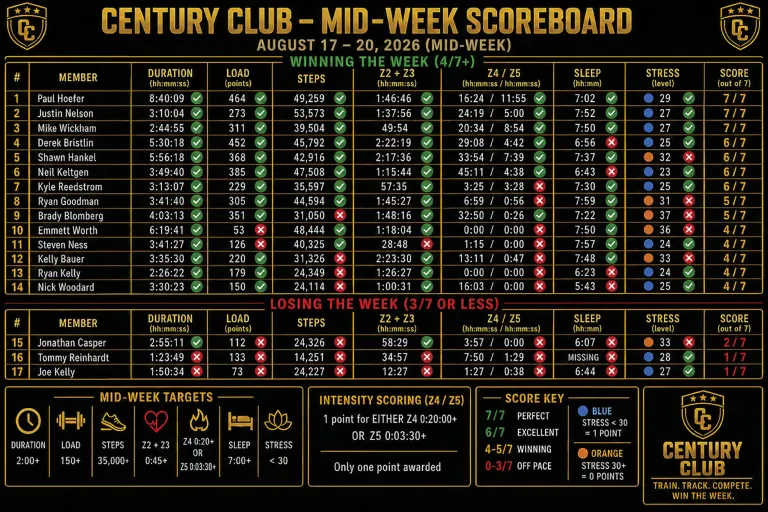
The mid-week scoreboard, updated for the whole club
None of those ideas is revolutionary. That is the point.
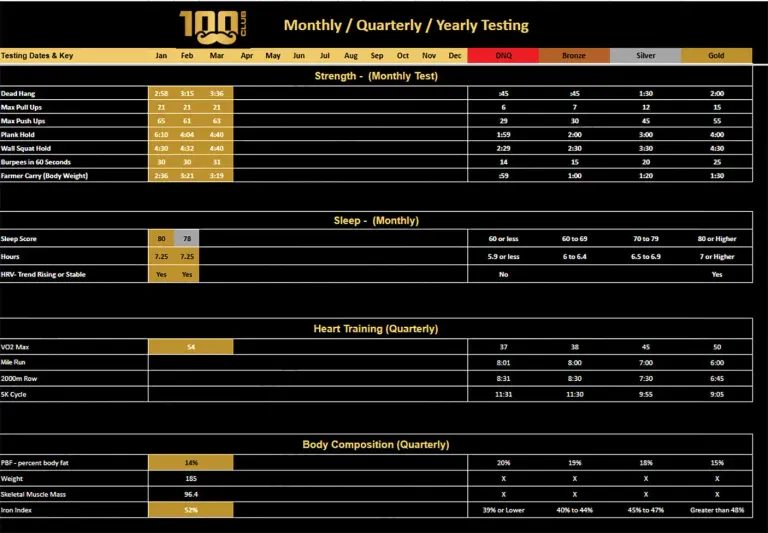
The testing sheet members train toward
Keltgen believes the health industry’s fixation on optimization has allowed people to overlook the power of repeatedly doing ordinary things. His members are not waiting to discover the perfect exercise program. They are building systems that make the essential behaviors difficult to avoid.
“Standards demand systems,” Keltgen said.
Standards demand systems
A member struggling to drink enough water does not need another lecture about hydration. He needs a repeatable structure. Keltgen’s own system begins with approximately 20 ounces soon after waking and another 20 around his morning workout. By 8 a.m., he has created momentum instead of leaving the entire standard for the end of the day.
“If it’s Neil’s standard, you won’t do it,” he said. “It has to become your standard.”
Keltgen readily credits author James Clear for shaping his thinking about systems and goals. Century Club turns that concept into something concrete. Members do not merely announce that they intend to become healthier. They establish when, where, and how the required actions will happen.
The weekly scoreboard
The weekly scoreboard then reveals whether those systems worked.
Garmin data allows Keltgen and the members to see training time, steps, exercise load, heart-rate zones, sleep, and recovery trends. A green check indicates that a weekly standard was reached. Members who hit at least four of seven benchmarks are considered to have won the week.
There are consequences for repeatedly missing the standards. Keltgen does not expect perfection, and illnesses or injuries are treated differently, but a member who continually falls short without engaging in the process may eventually be asked to leave.
That distinction matters. Century Club is intended to create accountability, not another app people can ignore without anyone noticing.
“Consistency is our superpower,” Keltgen said.
One scoreboard, many routes
The scoreboard may be universal, but the route to it is not. Keltgen does not require members to join a particular gym or complete identical workouts. One person might lift heavy weights. Another might work with a personal trainer. Someone else may rely on bodyweight exercises, a rowing machine, cycling, hiking, or swimming.
Keltgen likes running, but recurring hip discomfort has forced him to think seriously about alternatives. Other members may need to move from a treadmill to a bike, rower, or swimming pool when an injury appears. The exercise can change without abandoning the larger standard.
The program is equally flexible when life, not the body, gets in the way. One member became anxious about losing his perfect score while traveling with his family. Keltgen told him to stop.
“We are not chasing perfection,” he said. “Go have fun with your family on vacation. Lose a week. Don’t lose two. Stumble, don’t fall.”
Built for the long haul
Century Club is not promising a reinvention in 30 days. Keltgen wants to know what happens after six months, one year, and eventually five.
“Impress me by doing this for a year,” he said. “If you do it for a year, just think about what could happen in five.”
That philosophy also means learning to pivot. Health is supposed to make a fuller life possible, not become another obligation that prevents someone from enjoying it.
Editor of Fargo INC! — covering the founders, companies, and ideas shaping business in Fargo-Moorhead. Eleven years in, still no opinions, no politics, all business.