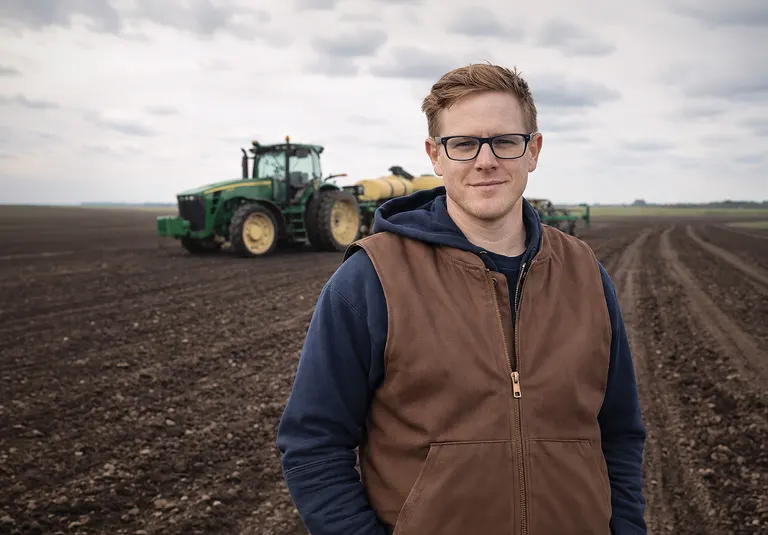
In shortRyan Raguse, CEO of Acre Almanac, describes building a farm analytics tool that uses statistical modeling and machine learning to create a private, data-driven record for individual farms.
3 things to know
1Acre Almanac applies statistical models and machine learning to a farm's own historical data to help farmers identify what variables drive crop yields over time.
2Raguse formed a Delaware C-Corp from the start and implemented a reverse vesting schedule tied to milestones, citing lessons from prior ventures including Bushel and Myriad Mobile.
3The founding team includes Nick Horob, Camille Grade, James Dravitz, and Jed Bonjtes, each contributing roles spanning software development, operations, marketing, and ag credibility.
Generated by Claude · grounded in this articleNever used on sponsored content
John Machacek, Chief Innovation Officer for the Greater Fargo Moorhead Economic Development Corporation, has worked with countless startups throughout our community over the years. He knows their ups, and their downs, but most of all, he knows the questions to ask them. Here are John Machacek’s 10 questions for Ryan Raguse, CEO and Organizing Founder, Acre Almanac.
1. Will you please tell me your elevator pitch to describe Acre Almanac?
Acre Almanac is part farm BS meter, part generational asset. We combine the long-range history of a farm with deep analytics to create a private almanac that belongs to that farmer alone. Over time, it becomes a living record of what actually worked, what didn’t, and why. Farmers who keep good information will have a longterm competitive advantage over those who don’t. Acre Almanac is built to unlock that advantage
2. I recall seeing an online post where you described how you’re building Acre Almanac as a serious tool for serious farmers as compared to other AgTech tools that may be more about hyped up dashboards. Will you please elaborate a bit more on that, which should help both me and the readers better comprehend what your company is doing?
There was a wave of AgTech products built around dashboards and maps that looked impressive but didn’t actually answer anything. No real analytics. No decisions.
That turned a lot of farmers off, and rightfully so. There’s also a group of farmers who have no interest in changing how they operate. Acre Almanac isn’t for them. It’s for the farmers who are constantly trying to get better. The ones asking “why” after every season. We built a serious tool for serious farmers. Not something to look at but instead, something to learn from.
3. Being that you manage your family farm, that obviously gives you a closer and different perspective, compared to a tech founder that doesn’t have that firsthand lens. I guess you’d also be in a spot to “eat your own dog food,” to use the phrase of a company using its own product. Am I correct in those assumptions?
Absolutely. And managing my own family farm gives me a very different perspective than you get from an ag business or even an agronomist. Ask five agronomists the same question and you’ll get five different answers. And product claims are hard to trust universally because every farm is different. There are too many variables to isolate what actually made the difference.
Crop yields are the result of hundreds of variables: weather, timing, soil, drainage, inputs, equipment, disease, and more. What Acre Almanac allows me to do is run those variables through a statistical model on my own farm. I can test changes, measure impact, and start to separate signal from noise over time. It’s not magic. It’s math, applied consistently over years of real data. And as that dataset grows, it becomes even more powerful when paired with machine learning..
4. With this being a newly launched offering, what are your strategies for getting the word out and in front of customers?
We’re being pretty deliberate about where we spend our time and energy. Right now, we’re not trying to do everything. Instead, we’re focusing on what actually works based upon our learned experiences.
That means leaning into earned media, tapping into our network across agriculture, and investing in content that builds credibility. We’re spending time with publications farmers already trust, having real conversations with people in the industry, and creating material that holds up. That looks like long-form content, educational videos, white papers, and thoughtful social media posts.
For what we’re building right now, credibility matters more than expansive reach. Serious farmers and agronomists don’t make decisions off a promoted post they pay attention to substance. So that’s where we’re putting our effort.
5. With your years at Bushel and Myriad Mobile, as well as your Virtual Farm Manager company back in your early 20’s, you have delved into ag technology. When did the plan for Acre Almanac start formulating?
The genesis honestly goes back to college. I was already thinking about regression analysis with spreadsheets for farming. I thought it would be incredibly valuable, but I wasn’t sure on the how or when. I didn’t even think of it as a software tool back then. If anything, I imagined it more as a consulting or advisory model and using analytics to help farms make better decisions.
Then life gets busy and you go on to different ventures.
I came back to the idea recently, driven by what’s happened with software development and machine learning. The math itself has been around for a long time. But now, when you layer in today’s technology and AI capabilities, it becomes something you can actually build and deliver. I couldn’t have done this costeffectively five years ago but now the technology has caught up.
And now that you can build software at a fraction of the cost and time it took even a few years ago, you can afford to be extra narrow and tailored. You don’t need to build at massive scale to make it work. Single-use software, built specifically for one type of farmer or one type of problem is finally attainable.
6. Were there any particular AgTech software startup learnings from cofounding Bushel; or if that was a bit more of apples and oranges, are there some broader learnings from being a more seasoned entrepreneur?
There are a lot of lessons especially in the broader sense of what it means to build a startup. Corporate governance. Product development. Not being too married to your initial pricing and initial positioning because that will likely change.
This time I formed a Delaware C-Corp right away instead of starting as an LLC. I’ve also learned a lot about structuring ownership partnerships thoughtfully. One specific example: we developed a reverse vesting schedule for the team, where we need to hit milestones to retain our shares. There are real tax and accounting ramifications to that structure, and it’s nuanced, but it protects everyone. There are a thousand examples like that one. Having those experiences behind me and the founding team means I can bring them all in from the start and skip a lot of pain down the road.
7. Thinking about your partners in this, from your initial Acre Almanac launch LinkedIn post from a few months ago, I recognized the names of those you mentioned that helped you co-found this, as people who have worked for various tech startups. Such as Nick Horob, Camille Grade, James Dravitz, and Jed Bonjtes. What roles did they play?
Camille often uses a phrase I love: “You can go fast alone, but you can go far together.” That’s exactly what this team is. Everyone brings different strengths.
Jed is a true software developer. He was there in the early days of Myriad Devices and is a foundational part of building what Acre Almanac actually is under the hood. James is a total operations guy. He helps get things done, keeps tasks moving, and makes sure the machine runs. Camille is exceptional at marketing and is a wonderful human to work alongside. And Nick brings an ideasforward mindset with real credibility and a great following in ag. He and I are similar in that we’re both like kids in a candy store with everything happening right now in tech, development, and AI.
The other thing I appreciate about this moment in time is that the access to modern dev tools means you don’t need a massive capital or outside investors to build something real. Everyone on the team can balance other interests while contributing, including me still farming. We can grow into what this thing needs at a pace that makes sense.
8. In knowing you for probably 12-13 years now, I would describe you a bit of a Renaissance Man in that you have a lot of various hobbies and activities outside of being a tech entrepreneur. We’ve already discussed farming, but I recall things like dirt bikes, car racing, EDM & DJ’ing, hiking and probably a bunch more. Are some of these things intentional actions and creative pursuits to find balance from tech/work life, or maybe are you just wired this way?
Honestly, I just like doing things. There’s no profound answer there. And there’s no better way to learn the “thing” than by doing the “thing.” I also might be a little addicted to adrenaline, whether that’s the fast pace of motocross, EDM, or a startup. They’re not that different from each other in some ways.
It’s not an intentional strategy, but it’s genuinely beneficial for me to not be in front of a screen. I’m a tinkerer by nature, so I could always be tinkering on something on the computer. Getting away from business life and burning off some energy is healthy. Over the last couple of years, I’ve gotten back into hockey, created a paintball team—which is something I hadn’t done in a long time, and done some serious mountain hiking over the last decade, including trips to Peru, Patagonia, Kilimanjaro, and Norway. Those kinds of experiences reset you in a way that another hour of work never will.
9. If you could back in time to visit with a younger version of Ryan, what kind of hindsight advice would you give yourself as an entrepreneur?
I’d tell myself to take the full picture seriously at every stage, not just the vision of where things could go, but what’s actually in front of you at any given moment. It’s natural to always be looking toward the next milestone, and that optimism is honestly part of what drives you forward. But when meaningful opportunities present themselves along the way, whether that’s a partnership, an offer, or a pivotal decision, give them the weight they deserve. The path forward isn’t always a straight line, and sometimes the smartest move isn’t the one that felt most obvious in the moment.
10. What can we do as a community to help you and Acre Almanac succeed?
Tell as many farmers as possible.
About John
John Machacek has been helping local startups with the Greater Fargo Moorhead Economic Development Corporation for over a decade. Before joining the GFMEDC ream, John’s career path has varied in areas such as banking, accounting, and management in the nonprofit, food & retail sectors.
Editor of Fargo INC! — covering the founders, companies, and ideas shaping business in Fargo-Moorhead. Eleven years in, still no opinions, no politics, all business.