10 Questions with John Machacek: Mason Ware (Ware Software) · Fargo INC!
People10 Questions · a column by John Machacek
10 Questions with John Machacek: Mason Ware (Ware Software)
John Machacek, Chief Innovation Officer for the Greater Fargo Moorhead Economic Development Corporation, has worked with countless startups throughout our community over the past nine years.
In shortJohn Machacek, Chief Innovation Officer for the Greater Fargo Moorhead Economic Development Corporation, has worked with countless startups throughout our community over the past nine years.
3 things to know
1John Machacek, Chief Innovation Officer for the Greater Fargo Moorhead Economic Development Corporation, has worked with countless startups throughout our community over the years.
2He knows their ups, and their downs, but most of all, he knows the questions to ask them.
3Here are John Machacek’s 10 questions for Mason Ware, Co-founder, Ware Software.
Auto-summary · grounded in this articleNever used on sponsored content
John Machacek, Chief Innovation Officer for the Greater Fargo Moorhead Economic Development Corporation, has worked with countless startups throughout our community over the years. He knows their ups, and their downs, but most of all, he knows the questions to ask them. Here are John Machacek’s 10 questions for Mason Ware, Co-founder, Ware Software.
1. Will you please tell me your elevator pitch for Ware Software?
Our main goal is to eliminate the friction businesses often feel online. You can’t just slap up a site anymore; you have to deliver a powerful digital experience. We handle that entire journey. That includes everything from building high-performance websites and mobile apps to creating entirely custom software, things like specific client portals, proprietary CRMs, or unique internal management tools. We design a solution that works perfectly, we build it to be highperformance, and we continually tweak it until it’s driving the results the client needs. It’s about getting the digital experience exactly right, whatever their needs are.
2. I believe Ware Software was formally created about a year ago. What have been your sweet spots, or hopeful sweet spots, as far as what the business is working on?
That’s right, it’s been about a year since we formalized Ware Software. But you could say the company started years ago when my brothers and I would brainstorm AI software ideas while playing PUBG together! After years of discussions, we finally decided to pull the trigger and dedicate ourselves to building software. The foundation is truly built on passion for technology, and the decades of tech experience all four of us brothers share. Specifically, my brother Bryan, a gifted full-stack developer with a real passion for coding, helped us establish the initial base of web design and hosting. Now, our sweet spot is quickly evolving toward custom software development. We love solving those highly specific needs that off-theshelf products just can’t address. We’re also heavily invested in developing our own products; it keeps us innovative, and that effort has led to fantastic networking and support in the FM area, especially through PixilAI.
3. Will you explain more about PixilAI as well as briefly share what some of those other internally developed products are?
Well, we actually showcase several products on the Ware Software site that came directly from my brother Bryan’s personal passion over the years. The most notable is PixilArt, which is an online drawing application and social platform where users can go to create and share art. It’s been incredible to watch Bryan grow that—it now has over 2.5 million users creating more than 750,000 new drawings a month. He’s truly combined his passion for coding and art there. Some other notable products he has created include Resite.Link, PixilNumber, and Ware AI.
The internal products officially developed under the Ware Software umbrella are slightly different. Our first project was the 1915(i) Provider Connect Portal. This allowed me to perfectly combine my passion for technology with my drive to help others. We identified a real problem with information lag in the 1915(i) program for behavioral health services. By working with the State of North Dakota, we launched this portal to better connect clients to providers. Since its launch, we’ve successfully connected over 200 clients to the help they need, which is a great milestone.
Next, we produced ChatBuddi. This is an incredibly easy-to-use, no-code AI agent designed to enhance any website or custom portal. It’s very slick: you just upload the knowledge base, insert the script, and you’re running a powerful AI chat. We primarily built this as an added value for our web hosting clients.
Our most recent product, and the one we’re most excited about, is PixilAI. This is an online EdTech tool that provides safe, engaging AI chatbots, allowing students to have conversations with historical, influential, and fictional figures. It’s designed entirely with education in mind, blending interactive learning with trustworthy AI safeguards, where educators and parents have the ability to monitor chats and receive alerts if chats become unsafe and inappropriate. This ensures that students can explore ideas and gain deeper insights in a safe environment. It’s a main focus for us right now. We recently soft-launched and we’re consistently refining it based on feedback from users and educators.
4. I’ve used Resite.Link for several years now for my email signature and LinkedIn profile. I remember this from when we first met for coffee a couple of months ago. You said the inspiration for PixilAI came after you were at a counseling conference for your work with Better Together North Dakota. One of the speakers shared information about young people using AI chatbots for conversations and relationships, and how it is not always safely and appropriately used or may lead to worse mental health. Will you share more about that problem you learned about?
That’s exactly right. I was in virtual training for North Dakota Counseling Association, and the speaker, who I believe was a professor from somewhere in Florida, was sharing concerns with how youth were interacting with AI. Young people were using general AI chatbots for conversations, sometimes even forming a kind of pseudo-relationship with them. After the training, I discussed these concerns with my brothers and we did some further market research and found there were a lot of AI products, like Talkie, that encourage young people to develop relationships and have conversations with AI. This type of product can obviously be harmful to kids and also hurt the adoption of AI. While I believe there can be a temporary benefit as a coping mechanism, it’s often not healthy for long-term mental well-being, and some of the conversations can quickly stray into inappropriate or non-age-appropriate territory.
Our take is that AI should be viewed as a tool, not a relationship. We wanted to create an AI tool that would teach young people how to use AI as a tool, specifically as a resource for knowledge, and at the same time, we wanted to make the tool fun to use; so that’s how the idea of PixilAI was created. Like I mentioned earlier, users will be able to have fun and engaging conversations with historical, influential, and fictional figures. And we have designed strong guardrails with a clear educational focus so young people simply cannot have inappropriate conversations with the AI bots. They get to learn about figures like George Washington in an engaging way, but they also learn how to use AI responsibly as a powerful learning aid.
5. The website for PixilAI looks great, by the way. When I was looking at it, I could see that there would be various perspectives from a user or paid subscriber. Such as the child or educator or parent. Can you share a bit more on those perspectives on how they may view PixilAI?
In regard to the perspective of the users, for the youth user, the value is the fun component. We’ve developed over 600 characters so far, mostly historical, but also some fun, fictional ones. It’s interactive, and characters like George Washington will stick to their historical domain and always follow up with questions that drive the user to learn more. For the parents, it’s all about monitoring and safety. They can monitor chats to ensure the conversations are productive, that nothing inappropriate is happening, and they can even get a glimpse into what their child is genuinely interested and curious about, which is great for understanding their emotional state.
We are currently running three subscription plans for PixilAI all of which have the guardrail features built into the chatbots and you only need an email to register for the plans. The first subscription plan is the Free plan which has limits on how many chats and characters creation, and may contain ads in the feature. The second plan is PixilAI+ where users will have the ability to create unlimited characters and chats with no ads. The third plan is the Educator+ plan. The Educator+ plan has an educator dashboard for educators and parents to monitor their students or child’s chats and get an overview of the type of conversations that occur with our sentiment analysis feature. Such as whether sad, frustrated, happy, curious, etc. The educator dashboard also allows users to create classrooms, lesson plans, and assignments for specific characters or eras. This feature is still a work in progress as we’re talking to a lot of teachers right now. The vision is an education dashboard where they can easily build lesson plans, assign specific characters, and utilize gamification features for motivation and retention. The challenge in the EdTech space is to balance those core lessons with the fun and engagement factor, and that’s what we’re working hard to validate and refine with their feedback.
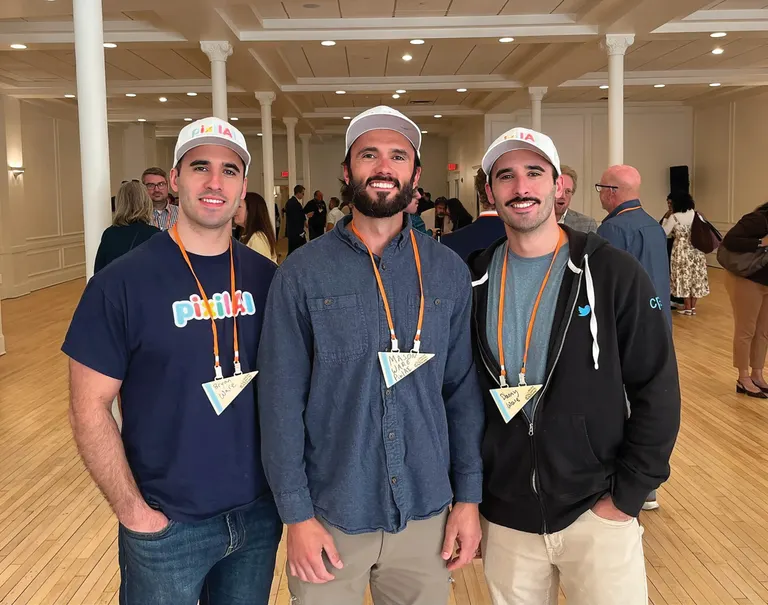
6. It was great to see you and your brothers at the Prairie Capital Summit this fall; and all with PixilAI swag on too! If I may ask, what were some of your main goals and/or biggest takeaways of attending the event?
That was a fantastic day, and yes, we were proudly repping PixilAI swag. Our main goal in attending both StartupBREW Fargo and the Prairie Capital Summit was to embed ourselves deeper into the regional ecosystem. For us, this means two things, first was validating PixilAI. We were looking for crucial conversations with investors, potential advisors, and fellow entrepreneurs to get objective feedback on our pitch and product roadmap. We had a lot of great conversations with people that resulted in some great feedback, some of which we have implemented on the website since.
The second piece was making connections. You can read articles all day, but nothing beats the rapidfire, high-value introductions and spontaneous conversations you get at events like StartupBREW and Prairie Capital Summit. It really highlights the incredible value and support that exists in the FM area for new ventures. We had a lot of great conversations with people that resulted in some great feedback, some of which we have implemented on the website since the event.
7. Since this is an entrepreneurship interview, I wanted to make sure to also ask about Better Together North Dakota, which you co-founded. This correlates to the 1915 (i) Connect Portal that was mentioned earlier. I guess this will be like a repeat of my first elevator pitch question, but how would you describe what Better Together ND is and does?
Absolutely, I love talking about Better Together ND. My business partner, Marie Knodel, and I officially launched the organization in June of 2022. The short story is we both share a passion for helping people, and we felt that more providers were needed to address the mental health and addiction increases we were seeing, particularly in the FM area. That passion was really sparked when Marie and I were both working as probation officers. We saw the need firsthand and felt our combined knowledge and experience could truly make a difference in filling those gaps.
What we do at Better Together ND is provide Care Coordination and Peer Support services through key programs like Free Through Recovery, Community Connect, and the 1915(i) program. We started right here in Fargo, and because the need has been so great, we’ve experienced significant growth over these last couple of years. We’ve since expanded our services to Bismarck, Grand Forks, and Wahpeton, and we’ll be starting in Dickinson this month.
We’ve been able to help a significant number of people throughout North Dakota. A huge part of that success comes from our emphasis on providing high-quality services, our strong collaboration with local organizations, and frankly, the incredible staff we have. Our team members are deeply passionate about the work they do, and that dedication truly shows in all the great work they achieve with our clients. I’m incredibly grateful for our staff.
8. With one of these final questions, I dug into your LinkedIn profile a bit. Knowing that the Ware family has been working in technology for a while and then also seeing your past work experience as a highway patrol state trooper and as a probation officer, like you just mentioned, I guess it would make sense that you may be driven to use systems and tools to enhance the physical and mental wellbeing of others. However, it is one thing to want to better help people, but another to have the agency to execute on that. Can you pinpoint any particular traits or experiences that helped you move forward on starting these companies, as opposed to just dreaming about them from the sidelines?
You know, the actual leap to entrepreneurship was less a sudden jump and more a gradual buildup of confidence. I’ve always had an inventive mindset. I was constantly questioning processes, asking, “Why hasn’t it been done this way?”. That likely drove my previous employers crazy. But it wasn’t until I saw my brothers, Bryan and Danny, actually build their own businesses, like Ware Repair and PixilArt, that I started seriously thinking, maybe I should turn my dreams into reality.
I wasn’t a natural risk-taker and had zero business background, so I took more of a sympathetic approach in my entrepreneurial journey. I earned my MBA to build the knowledge base, which then gave me the confidence I needed. I actively sought out mentors, got involved in my brothers’ businesses, and even started a small handyman business to learn the fundamentals of starting a business. This systematic approach, which I think comes directly from my time as a state trooper and probation officer, allowed me to build the confidence I needed to eventually lead to co-founding Better Together ND in a field I knew intimately.
So, if I had to pinpoint the two major catalysts for my journey, they would be my brothers’ initiative to start their own businesses and my own systematic approach to becoming an entrepreneur.
9. If you could visit Mason in the past, what kind of hindsight advice would you give yourself as it pertains to your entrepreneurial life?
My entrepreneurial journey just began five years ago and I’ve enjoyed it so far, so I don’t know if I would have too much advice besides take the leap earlier and start networking sooner. The amount of support, feedback, and crucial early introductions that exist in the Fargo Moorhead community is immense. I wasted time trying to figure things out alone. The key is just getting out there and connecting, because the people here genuinely want to help you figure it out.
10. Last question. What can we do as a community to help you and Ware Software succeed; or I guess even the PixilAI product and your Better Together ND organization too, if you like?
That’s a great way to close. We have a few key asks for the community:
For Ware Software, the best help is referrals. If a business needs a new high-performance website, mobile app, or a specialized custom portal, let them know we’re here to help them build it right.
For PixilAI, it’s still in the earliest stages and we need to get it in the hands of the people it’s designed for. We would love introductions to educators and school administrators in the region who can try the platform and give us feedback so we can continue to refine it into the best EdTech tool possible.
For Better Together North Dakota, the need is always awareness. If you know someone struggling with mental health and addiction, let them know we are here to help. We are also always looking for great people to join the Better Together team, so if you know anyone that wants to help please send them our way.
About John
John Machacek has been helping local startups with the Greater Fargo Moorhead Economic Development Corporation for over a decade. Before joining the GFMEDC team, Machacek’s career path has varied in areas such as banking, accounting, and management in the non-profit, food & retail sectors.
Editor of Fargo INC! — covering the founders, companies, and ideas shaping business in Fargo-Moorhead. Eleven years in, still no opinions, no politics, all business.