Frederick Edwards Jr. is a man who answers to many names; husband, father, poet, teacher, artist, speaker, mentor, entrepreneur, advocate, leader—to name a few. This spring, Frederick answered to another title, Bush Fellow.
What is it?
The Bush Fellowship, awarded by the Bush Foundation, is a prestigious grant aimed at nurturing leadership and fostering large-scale, equitable change across Minnesota, North Dakota, South Dakota, and the 23 Native nations within these states. The fellowship offers up to $100,000 over one to two years for recipients to pursue tailored leadership development plans. These plans could include further education, networking, and other resources—all to enhance their ability to lead impactful changes in their communities.
Candidates undergo a rigorous selection process and are evaluated on leadership potential and a compelling vision for future impact by a panel of alumni, staff, and community leaders. Only 24 leaders are chosen annually, making the fellowship both competitive and prestigious. Recipients are not chosen for specific projects but rather for their potential to achieve broader societal change.
Frederick’s story began in Minnesota, alongside nine brothers and sisters on the north side of Minneapolis.
“I grew up in the hood. Not like, ‘Oh, this is a rough neighborhood.’ Like I grew up really in the trenches,” Frederick said. “I think it gave me not only a sense of street smarts but also a bit of wittiness. I think I’m a lot more understanding about certain people’s situations, so I have a heart for homeless folks, those who have been incarcerated, and those who just don’t fit into whatever the ‘fit in’ is—I have a heart for those people.”
As the youngest of 10 kids and growing up in the environment he did, Frederick was exposed to an array of different cultures and experiences through his community and family. You can imagine the culture shock he had when he moved to Fargo in 2014 to attend North Dakota State University (NDSU).
“I started classes the first day I got here. I thought I was going to school in Montana, that South Dakota and North Dakota were the two bigger towns in Montana. I’m like ‘Where’s the cliffs, the mountains,’ he said. “I had only heard of urban farming. I had only seen farmers who had a local [farm] to restaurant type of vibe. My freshman year, we were in dorms with people who were pig farmers and cow farmers and so when I told people I don’t eat pork—you can imagine. They were like, ‘That’s an option?'”
This was Frederick’s first introduction to the state, and while the shared experience of being at college for the first time helped to create a buffer and sense of community for students, each has their own unique influences that they carry with them. For Frederick, this culture shock of a community drove him to seek out a sense of familiarity, and he made it where he couldn’t find it.
The university’s Black Student Association (BSA) was no longer active when Frederick arrived at NDSU, so he set out to help bring that back—and that was only the beginning.
“At NDSU, we didn’t have a whole lot of cultural experiences, things, or places to be, and so that’s when I started doing events. I didn’t even know I was good at events,” Frederick said. “And then I did my TEDx Talk.”

In 2017, Frederick got on stage at the TEDxNDSU event and bared his soul and story to the community. The talk, titled “Why I Must Speak Out About Racial Discrimination,” took listeners through Frederick’s journey of growing up in north Minneapolis and the facts of life that came with it, devasting and beautiful. He talked about his experience as a Black man. And, he pleaded for conversation. He asked listeners to reflect on racial discrimination, coming to them as a man who had experienced loss and grief. He spoke with confidence and conviction as he reminded those listening that no matter what you look like, your experience or skin color, there’s work to be done—and that we all can play a part in that.
Frederick addressed topics like gun violence, grief, racial discrimination, and ignorance—all things that are avoided in conversation because simply, they’re uncomfortable. And he did it in a way that held people’s attention and encouraged them to ask questions and discuss. While sparking this in others, he had unlocked something within himself too. He had found enjoyment and fulfillment in organizing, leading, and speaking at events, and he was good at it.
“In 2014-2015, a friend of mine was murdered by the police, Jamar Clark. That’s exactly five years from George Floyd. So there was a lot of that happening in my city [of Minneaoplis] while I was also doing these things here,” Frederick said. “And so for me, I thought, ‘You started BSA, you did TEDx, but what are you doing for the youth in this area? You know what it means to lose people, you know what it means to be at a sense of loss and grief.’ So I started to do these keynotes inside schools, I would go to Carl Ben Eielson Middle School, I did a commencement speech at the Dakota Boys and Girls Ranch, spoke at Youth Works helping homeless youth, and did all these different speaking things—and I wasn’t charging anybody. It was just passion.”
Through community connections and community encouragement, Fred’s Dissonance was founded.
The organization is all about bringing people together and celebrating what makes us different. Founded by Frederick, with a strong focus on amplifying the voices of the Global Majority, which includes people who are Black, Asian, Brown, dual-heritage, indigenous to the global south, and those who have been racialized as ‘ethnic minorities’, the organization aims to foster an educated, enlightened world that connects people through shared experiences and cultural exchanges.
With a committed team, Fred’s Dissonance, which operates under the wing of The Human Family, has successfully curated events that resonate with community values and the need for inclusive spaces. From Juneteenth celebrations with music, dance, and art, to Fargo Got Talent where local kids and college students show off what they can do, the events are designed to be low-cost and accessible, adhering to a “donate what you can” policy to ensure that financial constraints do not prevent participation.
In essence, Fred’s Dissonance continuously works towards a future where every member of the community feels valued, heard, and supported. Their extensive array of events and educational programs speak to the diverse community and provide a platform for people to celebrate and contribute to a collective, progressive future.
With Fred’s Dissonance getting its start, Frederick himself was embracing his role as a voice in the community and beyond. After graduating from NDSU with a bachelor of science in psychology, he started contracting with event work and poetry readings. He worked with the City of Fargo to host a Martin Luther King celebration and continued to grow that relationship into today. Now, Frederick, through Fred’s Dissonance, is the primary curator for the city’s MLK celebrations and he also heads the Juneteenth events across the state.
This summer, Fargo held its fifth annual Juneteenth event hosted by Fred’s Dissonance. It was also the second annual Juneteenth celebration in Bismarck, ND and Moorhead, MN, as well as their first annual event in Jamestown!
In addition to his work with Fred’s Dissonance, Frederick worked with Youthworks North Dakota. He has also been deeply involved with the Science Museum of Minnesota as a member of the Racial Justice STEAM Collective (RJSC), which is museum programming focused on integrating social justice themes into STEM education. Frederick has contracted with them to lead and conduct racial justice summits around the Minnesota and North Dakota region to teach kids about how STEM and racial justice are collectively correlated.
In Frederick’s experience, securing funding or sponsorships is a nuanced journey and one that his team at Umoja Inc. is continually navigating. He said their approach has been rooted in the power of relationships and community engagement. Here are some tips from him!
1. Cultivate Authentic Relationships: Engage deeply with your community. Listen to their needs, share your vision, and build trust. Authenticity is your greatest asset.
2. Leverage Existing Networks: Identify and connect with organizations and individuals who share your mission. Collaborations and partnerships can open doors to funding opportunities.
3. Showcase Your Impact: Demonstrate the tangible impact of your work. Share success stories, data, and testimonials that highlight the positive changes you are affecting in your community.
4. Be Honest and Transparent: Funders appreciate honesty about where you are in your journey. Share your successes, but also be open about your challenges and the areas where you are still learning and growing.
5. Stay Mission-Driven: Ensure that all funding and sponsorships align with your core mission and values. It’s better to grow steadily and sustainably than to compromise your vision for short-term gains.
Notably, as part of Youthworks programming, and what eventually became his thesis, Frederick, along with J’Neil Gibson, co-founded Umoja Writing Workshops—a 16-week program that provides primarily BIPOC students a constructive outlet for expression. These weekly workshops, held at various Fargo public schools, led writing exercises, cultural discussions, and music programming to improve student engagement, reduce truancy, and resolve conflicts. These classes weren’t serving as just another student engagement hour, Frederick saw— the programming was changing young lives.
“Me and J’Neil Gibson met right before COVID, literally right before COVID,” Frederick said. “J’Neil was this guy working with homeless youth who was like, ‘We want to give students an opportunity to learn about Juneteenth. I’m from Stockton, CA, can you and me connect?’ And I’m like, hell yeah we can connect. We connected and developed the [Umoja] programming in nine months and that program I ended up arguing to be my thesis. COVID happened and we were allowed to go into schools—we were the only program allowed to go into school. We were—masks on, writing poetry, connecting with these kids.”
Since 2020, Umoja’s programming has developed safe, inclusive, real places for youth in the classroom. The program supports students in positive development by fostering a sense of belonging, enhancing soft skills such as vulnerability, empathy, and expression, and above all, cultivating a strong sense of unity.
In 2021, Frederick won the Waterers Cultural Bearers Award, awarded by the organization, Racing Magpies. The recognition goes to individuals who work to bring culture into their community, in Frederick’s case, he referred to his culture bearing as Afrofuturism, which is what he works to introduce to and explore within the FM community.
Afrofuturism explores the intersection of Black culture, science, and technology through culture, philosophy, and history. Often incorporating, literature, music, visual arts, film, and dance, Afrofuturism can examine the past, question the present, or imagine an optimistic future, and is meant to inspire a sense of pride in their audience—Frederick’s work in a nutshell. He said he likes the idea of asking, “How do we think collectively about the future 100 years from now, and are black people in that future that you think about?”
In January of this year, Umoja Inc. moved from being a part of Youthworks programming to an independent nonprofit. The team made the decision, explaining that while they respect and value the work done while Umoja operated under YouthWorks, it was time for Umoja Inc. to pursue a different approach. With a focus on prevention, holistic development, and leadership for the youth, the focus is now solely on Umoja Inc.
Developing and leading both Umoja and Fred’s Dissonance over the years has filled Frederick’s cup, in both a way to serve the youth and the community at large.

Q&A
Q: How have you navigated successfully and integrated your personal passions with your nonprofit initiatives?
A: Navigating the integration of my personal passions with the initiatives of our nonprofit has been a journey of profound resilience and purpose. Fred’s Dissonance was born from a deeply personal experience—I was struck by a drunk driver in 2016. This life-altering event compelled me to envision and create a space free from the pervasive influence of alcohol, a sanctuary where creativity and healing could flourish unencumbered.
Two years later, Fred’s Dissonance became a reality, embodying a vision of artistic expression and communal support devoid of the shadows of substance abuse. It was a testament to the transformative power of turning personal pain into a source of collective empowerment.
Similarly, Umoja Inc. emerged as a response to a pressing societal need. The genesis of Umoja was catalyzed by the creation of the “RacismInNDSchools” Instagram page, where individuals courageously shared their experiences of division and inequality. This platform exposed a glaring lack of unity, not only within our schools but in the broader tapestry of our world.
Umoja Inc. is our heartfelt attempt to address this fragmentation—a bandage on a much larger wound. Our mission is to cultivate unity and foster an environment where every youth is seen, heard, and valued. By bridging the gaps that divide us, we strive to create a more empathetic community.

“I’m living so much in my purpose when it comes to the Umoja writing workshops, and then Frederick’s Dissonance is like this side hobby. Can I introduce people to sober fun activities where everything isn’t beer and tequila shots? At the same time, how do we as a community, who know very little about each other if we’re not from here, how do we cultivate and build community? That’s been my biggest thing,” he said.
Frederick’s work may not come as a surprise when you consider who he has looked up to in his life—his father being a local apostle and his mother being a former gangster from Chicago turned community caregiver—his work really makes sense. Frederick and his family have faced some family health scares in the last few years, including most recently, his father’s stroke.
“I always keep thinking to myself, like, do you want to work until heart attack or stroke? Or do you want to fill your cup up and then be at the best of your ability, so then you can also return that to kids? And that’s where the Bush Fellowship comes into play,” Frederick said.
Last year, Frederick applied to the Bush Foundation for a fellowship. The main goal he laid out in the application was to return to school to pursue his doctorate.
I’ve lost 43 friends, shot and killed. That’s an extensive, different type of cyclical grief that I have to deal with. So, getting a grief doula and having talk therapy, things that I could never afford, now are things that I have the opportunity to do. And even getting my educational doctorate—I never thought I would have a master’s, I never thought I would make it past the age of 18… So, for me, it was understanding that I had to get out of this war room of work and output which is a very North Dakota way of living—you are measured by how much you work and how fast you work. And it’s almost never about how much heart or intention you put into things.”
The whole idea of the Bush Fellowship is that its awardees are already proven changemakers, discussion-havers, and culture-bearers—now, they have permission in a sense (along with funding and support) to take a step back and invest in themselves. Through the award, they are empowered to grow personally and professionally in their leadership skills with the overarching goal of a larger community impact. Instead of focusing the award and its perks on an organization or foundation, it’s focused on the individual leader.
“So, if I want to change the culture and community here, [I have to invest in myself]; and by change, I don’t mean it’s terrible, what I mean is we always have work to do to be a better community and more inclusive,” Frederick said.
The application process took about seven to eight months.
After the initial application in the fall, about 100 semifinalists are announced in November. Then, foundation staff members choose up to 36 finalists to move on and announce in February. He laid out his plan and was honest.
“With the changes that I was going through, I need rest. I need racial healing rest; take out the race, as a man, I need masculine healing; take out gender and race, just as a human, I want to be able to connect and build rapport with my community and people around me, and not always being ‘Fred, the guy who’s the founder of this and co-founder of that, and can you help me get to here?’ I think I’m oftentimes called to different places and spaces, and I’ll never complain about that, but the Bush Fellowship is asking, ‘Do you have a track record of success, and do you need a break?'”
Part of the reason why Frederick is in such need of this rest is the fact that the type of work and support he serves is traumatic, he called it secondary trauma. Especially in the youth who connect with him and share devasting stories of their everyday lives. One day he will be talking with people in triage who are struggling with fentanyl addictions, and the next he will be having lunch with the mayor at BernBaum’s. Frederick lives a very dual life.
Along with rest, Frederick explained in his Fellowship plans that he was going to also be returning to school. Having his bachelor’s and master’s degrees, Frederick will be working towards getting his doctoral degree. The Fellowship selection committee chose up to 24 applicants to join the fellowship, and in June of this year, the official 2024 Bush Fellows were announced and Frederick was named 1 of 24.

“It’s really unique and cool to see this evolution over time to where I went from a very amateur speaker—Eric Hatch was my voice coach—to me now being in his leadership classes, or training kids with leadership, and now they’re the ones performing at MLK. Now, they’re the ones who are planning events,” Frederick said. “This idea of passing the baton, that’s starting to happen. And I think that’s where I am now. In 2024, I’m not taking as many speaking gigs, or as many poetry performances, I’ll give it to my students.”
With his induction into the Bush Fellowship, Frederick’s opportunity to take a step back from the day-to-day operations of his nonprofit work and further his education began to become a reality. It’s not always easy to “pass the torch” per se, especially when it comes to a project one is deeply connected with, so we asked Frederick if he was nervous about pulling back.
“Nervous is not the answer that I have. I am uncomfortably excited,” he said. “I’m excited but very uncomfortable to be excited because I know that God works in mysterious ways and that whatever is going to happen is going to happen. I know that I have students in mind who can lead some of these events and programs that I’m doing. I know that we have 19 interns from MSUM coming next year to help out with Umoja. I know that our board is going to make sure that we get the support that we need. So, I think they see this [Fellowship] as an investment into Umoja, see this as an investment not only to Umoja because I see Umoja as a part of North Dakota, but as an investment into North Dakota.”
He pointed out that the last person who was awarded a fellowship from Fargo was many years ago, and that’s exciting to see North Dakota being put on the map for, “wanting to make a change for belonging, for good energy, for healing.”

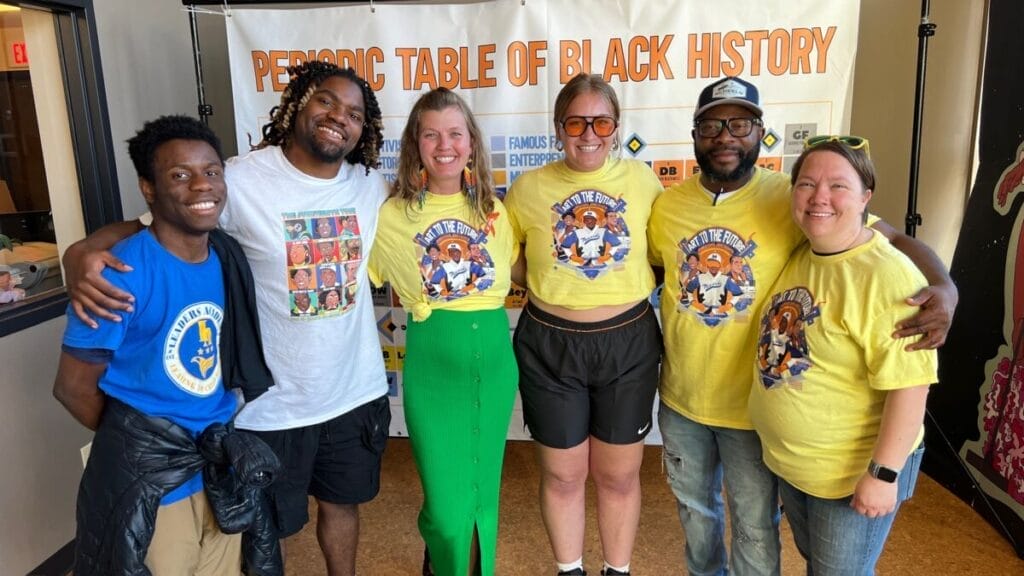

“If somebody is like, ‘Fred, I took your spot, you can’t come back here and do the same stuff,’ I’m gonna be so fucking happy. Me and J’Neil wrote in our business plan—we want somebody to work us out of this job. Our goal is not to have to keep on creating unity in schools, we want schools to automatically do it,” he said.
Frederick says his TED talk he did back when he was 19 is what most people know him from. And while his 90,000 views on the official TEDx YouTube channel might suggest that’s where people outside of the community know him from, we’d argue that the FM community knows Frederick Edwards Jr. for his unwavering dedication to making the community an informed, empowered place.