Dynon Avionics Makes an Entrance to Fargo Moorhead · Fargo INC!
People
Dynon Avionics Makes an Entrance to Fargo Moorhead
Brad Thurow and Tucker Richardson are well-versed in the game of innovation. Thurow has over 17 years in the engineering world and Richardson has 14 years himself. Both have already made major impacts
In shortBrad Thurow and Tucker Richardson are well-versed in the game of innovation. Thurow has over 17 years in the engineering world and Richardson has 14 years himself. Both have already made major impacts
3 things to know
1Brad Thurow and Tucker Richardson are well-versed in the game of innovation.
2Thurow has over 17 years in the engineering world and Richardson has 14 years himself.
3Both have already made major impacts on the local entrepreneurial ecosystem—both are founders, Thurow co-founded Packet Digital and Richardson founded GEMSHO, and both made significant contributions at Appareo, where they worked together.
Auto-summary · grounded in this articleNever used on sponsored content
Brad Thurow and Tucker Richardson are well-versed in the game of innovation. Thurow has over 17 years in the engineering world and Richardson has 14 years himself. Both have already made major impacts on the local entrepreneurial ecosystem—both are founders, Thurow co-founded Packet Digital and Richardson founded GEMSHO, and both made significant contributions at Appareo, where they worked together. Now, both are working for Dynon Avionics, a company they are partially responsible for bringing into the Fargo-Moorhead area.
What is Dynon Avionics?
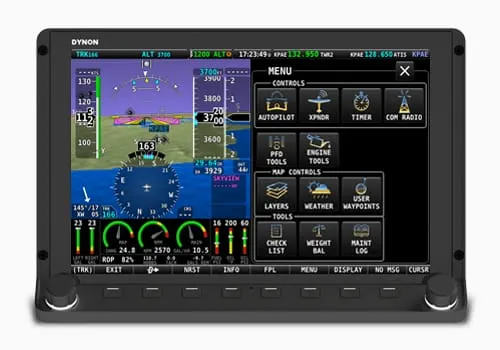
“We manufacture and engineer avionics and we do it for small aircraft, primarily personal aircraft,” Thurow said. “Most of our customers fly their own airplanes and they’re using our products as avionics. The thing that gets noticed first of what we design and build are the glass panels—they show all the flight information, engine instruments, the moving map, and we do cool things like synthetic vision that shows the pilot where he is in space. So, we manufacture those large panels and all the engineering and software behind it. However, we also engineer and manufacture everything else that an airplane needs to fly like radios, inertial systems, and GPS for positioning. Including that glass, we do all of the design and manufacturing of that. That’s our product line. We’re all in for small aircraft. One unique thing about the products we make is many of our customers are building their own airplanes. I think between 1,000 and 2,000 airplanes a year get built through kits. Then, they need avionics so they can fly. The only thing we don’t make for these planes are the engines and the metal.”
By The Numbers
33,000-34,000 amateurbuilt aircraft are estimated to be registered by the Federal Aviation Administration in the United States.
1,000-1,500 homebuilt aircraft, on average, are completed and registered with the FAA each year.
“Many of our customers are literally building their airplanes in a shed—they’re hands on,” Thurow said. “It’ll take them between one year and five years because it’s a hobby, it’s something they’re doing on the side. Sales to certified aircraft manufacturers make up a significant part of our business as well, but I think it’s interesting how many of our customers are doing it themselves.”
The Birth of Dynon Avionics
John Torode, a serial entrepreneur with an intense passion for flying, founded Dynon Avionics. His avionics journey started over twenty years ago when he recognized the opportunity to improve flight safety using technology. At the time, analog dials dominated aircraft instrumentation, Torode and a small group of engineers designed and built the first glass panel for small aircraft: the D10 and things progressed from there. Or, as he will joke, “the hobby just got out of hand.”
This innovation allowed the display of critical flight data in a way that was more humanly intuitive and accessible.
The Unique Appeal of Dynon’s Products
One of the hallmarks of Dynon’s products is easy access and easy installation. The company has everything from the basic components to the whole panels for anyone building an airplane. This flexibility caters to the many different needs of its customers, most of whom are hobbyists making their aircraft.
“Our products are designed with the builder in mind,” Thurow said. “Whether they’re buying individual components or a complete panel ready for installation, we do everything we can to make it as easy as possible.”
Why Fargo-Moorhead?
The decision to extend Dynon into Fargo-Moorhead was clearly based on great aviation infrastructure, with a top-ranking aviation university and good business support. Thurow, who himself was well experienced within the local tech industry, saw many reasons to expand to the metro.
“It was clear that expanding here was a no-brainer,” said Thurow. “Local universities have been producing some of the best engineers, and the local community support for innovative companies has just been great. This is an aviationfriendly state and it has all the ingredients we need for success.”
Brad Thurow, VP Engineering, Dynon Avionics
This expansion also brings Thurow full circle. The Minneapolis native previously worked in Fargo at Appareo, where he and Richardson were involved in new product development. Their understanding of the local market and confidence in its potential was an important factor in Dynon’s decision to get on the ground in the area.
The Fargo Team and Plans for the Future
The original team in Fargo is small, just three, and focused on the Dynon flagship product line: SkyView. This sophisticated avionics system consolidates multiple flight and engine instruments into one-view so pilots can be fully situationally aware of their airplanes. The team works on new functionalities that bring new experiences and uses to the SkyView system.
Even though it started out with just a few hires, Dynon has plans to expand its team in Fargo going forward with the settling-in of the new office and as projects take off. As things expand, Richardson anticipates deeper engagement with the local community and universities.
A Commitment to Customer Experience
A major part of Dynon Avionics is the customer-centric focus. Many of the people in the company, including Thurow and Richardson, are pilots themselves and are in a firsthand position to understand the needs and difficulties of their customers. This firsthand experience informs product development and support strategies in ways that ensure offerings are the best they can be.
“Dynon is a company founded by pilots for pilots,” said Thurow. “Our strong relationships with the aviation community lets us deliver products for their real needs.”
“There’s nothing cooler than being part of a team that creates something impactful,” Richardson he said. “Our goal is always to do the best for our customers and exceed their expectations. That’s what gets me fired up about what I do.”
Future Outlook
Entering the Fargo-Moorhead market is not only about business expansion but an investment in technology and the economy within this region. The company plans to continuously build collaborations with local universities on research and development works to create a strong pipeline for both innovation and talent.
“What we want to do is really add some value to the area of Fargo,” said Richardson. “We’re very interested in what’s going on around here, and ready to build a team that delivers great products and adds value for the people while contributing back to the local community.”
Advice From Tucker Richardson on Providing a Great Customer Experience
Tucker Richardson is an expert on customer experience. Here are a few tips he has for those looking to improve the way they interact with their most important form of revenue.
By Tucker Richardson, Engineering Program Manager, Dynon Avionics
I think one interesting piece of advice regarding product delivery is the value of focusing almost exclusively on your customer, rather than your competition.
It seems to me that the primary starting point for most people is to begin a product development effort by first attempting to “one-up” the competition or plug a “feature-hole.” This often looks like a huge spreadsheet of competitors cross-referenced against their features for the purpose of ultimately claiming, “We are going to do everything the competition is doing plus this ONE SPECIAL THING,” or, “Here is something the competition is not doing, and this ONE SPECIAL THING is what we’re going to do to win the game.”
Sounds highly logical, right? It certainly is. But there is one major problem with this strategy.
Nowhere in the above thought process did I mention the customer, the person who actually must open their wallet and part with their hard-earned money in exchange for your product. Executed to completion, this competition-centric thought process often results in a product reaching the market only for you to realize the customer never actually cared about 90% of the features your competition was offering and/or they definitely never cared about that “one special feature” you hinged your success on.
Alternatively, rather than spending 90% of your time analyzing the competition (which, by the way, is a never-ending battle), why not flip the script and spend 90% of your efforts focusing on your customer? If done properly, this level of customer focus tends to flesh out, with a high degree of accuracy and precision, what your customer is actually seeking. Understand what your customer is seeking, and you are far more likely to:
Offer the customer exactly what they want
Do so at the most competitive price because your product is not bloated with low-value features
Deliver faster because you are not wasting your time developing low-value, unwanted features
In practice, a customer-focused mentality can include customer interviews, customer observation, proof of concept/beta testing, or otherwise doing everything possible to define your customer and figure out what they want with the greatest degree of accuracy and precision you can manage.
This may even include becoming the customer yourself! For instance, if you’re going to develop a fishing product, it may not be a bad idea to spend a few months exclusively fishing before doing anything else. The same goes for the development of avionics; if you’re responsible for value-based product decisions, the best thing you can do for your customer is to become a pilot (or even a maintenance/service technician, given these are the people who install the equipment).
Of course, these are only a few examples of the different ways you can apply customer focus, but it is impossible to do any of them at an elite level if the majority of your time and subconscious is enveloped in an obsession with the competition.
Editor of Fargo INC! — covering the founders, companies, and ideas shaping business in Fargo-Moorhead. Eleven years in, still no opinions, no politics, all business.